Showing posts with label islam. Show all posts

Friday, January 30, 2015

Ma'a Salaama, Doha: No Regrets

Dashboard entertainment:

yes, this really happened
at 80km/hr
But first, this happened:

Landcruiser idled in traffic
driver's door open
errant youth chastised;
traffic waited
without honking horns
even though the light was green
 
Sure, driving in Doha is hazardous. Living in Qatar is like residing on a construction site surrounded by a construction site within a construction site bordered by a yacht-and-dhow-sprinkled moat overrun with princes.
 
Abandoned buildings disintegrate in the wind and sun. Roads are rerouted to accommodate construction needs. Appointments, schedules, contract dates and terms-set-in-stone are fluid. No mail service. Empty grocery shelves, the metric system. Familiar, brand name products - made for an international market - taste or work differently. Services are discontinued without notice. Wet summer air puddles under thresholds, teases body moisture into clothes. Salty water stings eyes, dries skin. Rules about alcohol, behavior, attire. A mysterious, minority host culture. Prejudice, bias, wasta. 
 
And, yeah, traffic.
 
a different kind of traffic picture:
bare road plus
parked, red lakhiwiyya police SUV...
black sedan, tinted window
convoy
headed your way
 
But life in Doha is not all teenage boys, plugged intersections, rebar and concrete. For example, there is year round sunshine. Seasonal pink flamingos, the souk. Gucci, Hermes, Giorgio Armani. Porsche and Lamborghini. Tennis, handball, camel racing, the Call to Prayer, cute baby giraffes.
 
the Doha Zoo remains closed
this is what it looks like when you drive in unannounced
while the guard is on break
(then charm your way out in pigeon Arabic)
 
Less than 100 years ago, Qatar was a vast expanse of sand. Today there are flowers and malls. Date palms hem a brick Corniche around a glittering Bay. An eccentric high rise skyline ponies up nighttime bling. The country's National Museum (under construction) is uniquely shaped like a Desert Rose. Three short years ago stereo speakers fixed in The Pearl's trees broadcast bird calls. Today real birds flutter in the fronds.
 
behind the walls
a community park
Shehanniyah
 
Growing pains feature in Qatar's dunes-to-mansions story. But rapid growth is the tale's hero - and villain. Now, as we leave the desert behind, we choose to focus on the experiences that made our time here memorable.
 
racing camels and trainer
 
camel jockey
once upon a time small children filled this role
today's jockeys are politically correct
monkey shaped robots
 
The People
Coworkers, desert strangers, locals, teachers, friends. Qatari women who invited me into their homes, shared cultural secrets and personal stories. Bob's golf buddies and the international team at Weill Cornell Medical College's Standardized Patient Program. More profiles than time to write.
 
Niqab and glasses
Read about it:
 
Places
Deserts, beaches, resorts, churches, castles, pubs, B&Bs, spas. Ten countries, many cities. Exploring sand and rock from one end of the peninsula to the next.
 
Chris meets Corniche pearl
 
Read about it:
 
Time Together
A three year Qatari honeymoon. Opportunity to show our kids the world. Friday walks, trips to the desert, touring the Irish countryside in a Beemer.
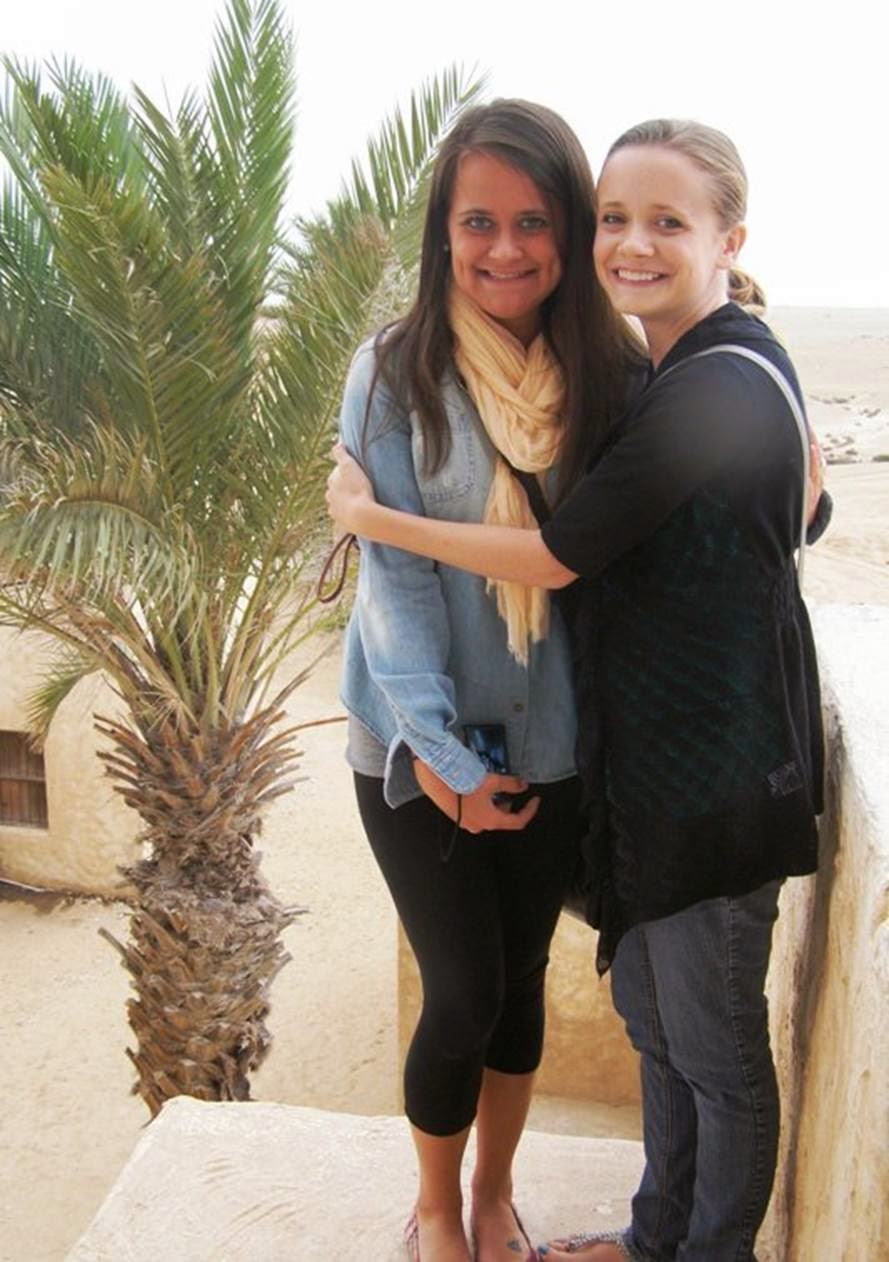
 
ma sha allah!
Katie and Kimber at Film City
 
Read about it:
 
Culture and Language
Six day work weeks and unrelenting traffic didn't leave much room for sightseeing. Still we managed to learn some Arabic and gain understanding of a sometimes mysterious culture.
 
Bob and Cindi meet Qatar's Peace and Love Guy
 
Read about it:
 
We leave Qatar now with quivers full and no regrets. Ready to love on our kids, grandkids, family and friends. Paint our kitchen, seed our lawn, plant a garden. And prepare for life's next great adventure.
 
 
yallah habibkum!
This is the end.
Journey over;
new tale begins.
 
Disclaimer:
The essays in this blog reflect our experiences while living in Doha, Qatar during a particular 39-month period. Qatar is a new and evolving country; today, street names, shops and restaurant locations change overnight, tomorrow the landscape may be different. We hope you'll gain a positive appreciation for Qatar's people, religion, culture and history through our experiences.
 
ma'a salaama
ciao
arrivederci
adios
auf wiedersehen
illa liqah
'bye now!

Thursday, September 25, 2014

Goodbye, Lighthouse...?

In Arabic, fanar means "lighthouse."


In the same way a lighthouse illuminates safe passage for those seeking the comfort of shore, Doha's Fanar Islamic Cultural Center seeks to share the good news of Islam with the world - and you.
 
Inside, a wide, two story, tiled entry. A guard at a podium. An ornate split staircase leads to a first floor balcony. A tall vase stands at the heart of three doors.
 
To the left is a majlis meeting space with authentic-ish red and white cushions. Glass bookcases highlight Qatar's achievements and a ceiling mural depicts the country's proud history.
 
The middle door opens into a narrow hallway filled with cozy leather couches where, if you sit, a bearded man in a long white robe might bring you a glass mug of sweet Arabic tea. "Welcome, welcome," he'd say as you peruse ancient Korans and other artifacts in square wooden display cases and read a book about Islam etched on the walls in life-sized, full color print.
 
 
A third door, to the right of the vase and tucked under the stairs leads to the Ladies Section.
 
This is where women from all over the world - including Qatar - meet for the purpose of spreading the good news of Islam - that all, including you - might see the light and be saved. If you are persistent, you might learn some Arabic here too.
 
You visit the lighthouse this week in hopes of enrolling for an Arabic class. After three years of study and association, all that remains is the final course in the Center's five level program.
 
But it seems that Fanar is under new management. The familiar, hardworking teachers you'd come to know are gone; fired. Arabic class times are limited. In the same way that laws pertaining to freedom of speech took your blog, and malware lodged in your internet provider curiously limits access to your own website…new rules promise to swallow your Arabic classes too.
 
An optimistic woman in black pledges to intervene on your behalf. "I will ask him to make a time for you," she says. But she does not add in sha allah.
 
 
You pay the fee for a class that doesn't exist in hopes of maintaining a connection. Then you leave the way you came in: through the door tucked under the stairs.

Friday, June 13, 2014

How to Read Arabic: Four Easy Steps

Arabic Calligraphy made out of Arabic Calligraphy
 
It was a simple list of Arabic words, neatly typed in easy to read font, evenly spaced and aligned in a column. "What does it say?" said my friend.
 
I recognized letters, identified familiar words, comprehended general meaning. But understanding shrouded itself in my mind like a fortress sealed for battle. I returned the page in defeat.
 
"That's okay." She shrugged. "I'll ask someone else."
 
Ouch.
 
As I see it, there are four steps to reading Arabic:
 
1) Identify letters.
 
The language does not utilize capitals or "cursive," but there are three shapes for each of Arabic's 28 letters, plus vowel markings, dots and sometimes dashes. There's stylized and sloppy writing, contracted spelling, stacking, dropped dots, added curls, lines, circles, hooks.
 
two ways to write Daad
 
And there's Arabic calligraphy with its flourishes, lines, circles, vowel markings and decorative symbols:
 
this says: "Al Jazeera"
 
الجزيرة
this says "Al Jazeera" too
 
Reading Arabic is often a rousing game of "Where's Waldo" but with letters instead of people.
 
2) Read the word.
 
Congratulations, you've located the letters! Now you're in a position to make sounds. In English this is the part where your index finger hovers over diphthongs, blends, consonants, vowels. Is the sound long or short, hard or soft, speak its name or remain silent?
 
Reading in Arabic requires the same step, only without vowels, which, by the way, do not commonly appear in the everyday literary Middle East scene - ie, newspapers, street signs, television commercials, correspondence, textbooks, event flyers.
 
"(Vowels) are for babies," said Teacher. "You will understand from context."
 
Kitty likes her harakat (those squiggles over the letters: vowels)
"Kitten," from an idea by Andrea Dami, illustrations by Tony Wolf, Text by Silvia D'Achille

Oh yeah, you're expected to elucidate vowels when reading. It's just that they're not provided (once you graduate from board books).

3) Comprehend meaning (of individual words).
 
Way to go! You've identified letters and applied sound. Now you may translate.
 
Only…factoring in the million or so Arabic dialects, Koranic use, invisible vowels and what happens to meaning when you add "the," conjunctions, prepositions or adjectives…each word in Arabic has approximately 400 different definitions. (I might be exaggerating but only slightly.) Some meanings are literal and unique like, for example, this word:
 
شعر
 
which may mean poetry, to feel - or hair - depending upon where your mind applies that missing vowel.
 
اشعر الشعر و الشعر.
 
I feel poetry and hair.
 
Other meanings are less literal, like this word:
 
فكر
 
which is pronounced "fakkr" (yes I know what it sounds like in English) and means, generally, "to think" (along with variations on the theme like "contemplate, idea, intellect, consider…")
 
(When a different invisible vowel is applied) this combination of letters also refers to a prayerful thinking-on-God activity called "fikr" where observant Muslims caress prayer beads and speak God's name over and over. This form of contemplation results in heavenly reward.
 
prayer beads
 
"One minute of fikr is equivalent to a year of worship, and one hour of fikr competes with 60 years of worship."
 
4) Understand.
 
You've found the letters, recognized words and have a general idea as to meaning. Now, relax. Drink tea. Release understanding into your mind in the way that steam floats from a mug of sweet Arabic coffee to warm cold fingers on a snowy day.
 
Snow in Egypt, 2013
 
At least that's the idea.
 
words shaped like a flower
 
Hours later, long after my friend and I had gone our separate ways, understanding danced in my head like rain over the Sahara: too late.
 
Arabic isn't just nouns, verbs, adjectives (and a bunch of other things that don't translate). It's more like an orchestra of colloquialisms strung together by sound. You don't translate as much as absorb the secrets in the melody and rejoice in the harmony of understanding.
 
But first, you must locate the letters, drink tea - and wait.
 

Friday, June 6, 2014

Machbous, Prayer and God

Each guest received a laminated cookbook
 
The voice echoed pure, smooth, clear off stone walls and tile floors, sailed into the glass dome that fed light into the majlis space, filled every corner of the larger-than-my-apartment rectangular shaped room. Full, rich, angelic. Trills over a monotone, alto to soprano, singing but not.
 
More than 50 women from France, Germany, Spain and other countries settled into couches along the walls. Voices quieted. Movement ceased. Conversation ended. The only sound was the smooth, honey textured voice.
 
A rustle hummed beneath the melody, just a whisper. I searched the room for a microphone or stereo, but there wasn't one. All eyes seemed to be focused on the high arched entryway, just outside my field of vision.
 
We'd been invited to attend a presentation about prayer and Ramadan offered by the Qatari Women's Association (QWA) for ladies from organizations throughout Doha. I'm not a member of any group, but learned about the program through a Qatari friend.
 
ready to learn about Ramadan and prayer
 
I emailed interest and provided the name of our inviter. I received a map to our host's home: a walled villa the approximate size of a city block located just outside town.
 
The gate was ajar. Inside, a freshly dug garden surrounded a wide covered porch and concrete patio. Thobe-wearing little boys with skateboards scattered as we approached. We climbed the stoop, pushed the glass door, stepped over the threshold.
 
Inside, a group of Qatari ladies dressed casually in jelabiya, suits and dresses circled a wide entry. Thick rugs were placed neatly over tile under a high ceiling. Warm arms enveloped us, pulled us close for hugs and kisses and passed us from one woman to the next. How are you? Where are you from? We're happy you're here, welcome, welcome! Please sit, would you like something to drink?
 
We twisted, turned, hugged, squeezed, kissed, touched cheeks, chattered in the traditional Qatari greeting - until we popped out of the huddle through the arched opening and into the tile floored, domed living room/majlis/meeting space.
 
QWA women made their way around the walls of the majlis shaking hands and offering kisses. Our hostess's young daughters offered tea, water, soda and bright, welcoming smiles.
 
In Islam, a smile is considered a charity and a gift
 
Our speaker sat in a chair at one end of the room. There was tea and soda and low tables for cookies and drinks. There were familiar faces, new friends, questions, answers, good conversation.
 
And then, without accompaniment, microphone, or introduction - this sweet voice.
 
I left my cushioned seat, stepped into the middle of the room, turned toward the arched opening.
 
In the entryway before the front door were three lines of women wearing black abaya and sheyla. They stood shoulder to shoulder, eyes closed.
 
In the middle of the front line a young woman raised her head and her clear voice sailed forward.
 
In Qatar, a woman may lead the women's prayer.
She receives no special training
and is called an imam, just like the leader of the men's prayer.
In a private home, the imam is usually the hostess
but may be anyone who knows the "rules of prayer."
The Maghreb prayer always has an imam.
It's better to pray congregationally than alone
but either are acceptable.
 
Following the angelic uttering, each woman's lips moved silently. All together, in harmony, synchronized through years of piety, they stood, kneeled, bowed, head lowered to the floor, stood again. Behind the last row, two women sat on plastic chairs near the front door. When lines of ladies' heads bowed, the sitting women lowered heads too. When lines of ladies stood, sitting women sat high in seats.
 
How to Pray
From My Prayer Book, Darussalam
 
I'm not Muslim and don't know the prayers or rules of prayers but from the looks of things (and factoring in my own biases), I imagined the young imam uttered the Muslim version of this:
 
"Now we'll do the part where we pray for special intentions…"
"Bend at the waist, ladies…"
"Tap your knee once here…"
"Raise palms to your face and lower them while saying Allah…"
"Kneel and say this…"
"Get ready to stand…"
"Turn to the left and then to the right and repeat after me: salaam alaykum wo rahmat allahee…"
 
How to Pray
From My Prayer Book, Darussalam
 
A final note and then, it was just - over. Eyes opened, lines dissolved. Some ladies sat on the floor where they'd ended, others gathered in groups or wandered off.
 
Only an echo remained. God?
 
louqaimat
saffron and cardamom donut holes-ish fried in honey
melt in your mouth deliciousness
 
Later, the wide entry was stocked with long tables and food: chicken and lamb machbous, harees, madrouba, louqaimat and more. Each member of the QWA had brought a local dish, potluck style. Take away tins were provided so guests might share the culinary wondrousness with the folks at home.
 
Welcome
 
Tea, conversation, information, friendship, machbous, prayer and God. What could be better?

 QWA Machbous Recipe
QWA Machbous Recipe
(My favorite Qatari dish)

Friday, April 18, 2014

Charles Hedrick Birthday and Poetry Month: On Niqabs and Tattoos

Charles Hedrick

April is milestone birthday month for my dad, the theologian, author, rabble rouser and poet, Charles Hedrick.
 
Read Charlie's blog where he waxes scholastically philosophical on all things God, Jesus, Mary and Joseph, Bible, spirit, soul, peace, prayer and much more. (http://blog.charleshedrick.com)
 
Visit Charlie's website to view presentation videos, pictures, and learn more about Charlie's latest publications. (http://www.charleshedrick.com)
 
As all Charlie ever wants for his birthday is socks and poems, I'm posting this month's blogs in 80 word meter, a number which may be important to Charlie's big celebration (but you didn't hear it from me).
 
poet, linguist, theologian
April's posts are written for him
(but if there's a royalty
endorse those checks over to me)
 
Happy Big Birthday Month, Dad.
 
 
On Niqabs and Tattoos
 
Tattoos are haraam, forbidden;
they're permanent, cause pain and change
the body which God created.
 
Our hostess removed her niqab,
and scarf and answered questions on
covering, Islam and tattoos.
 
All Muslim women don't cover,
said the Iranian, her scarf
draped loosely over tinted hair.
 
And, my eighty-seven year old
mother, prayerful Muslim woman,
just got her first tattoo. I thought,
 
Except for the permanence, scarred
skin, pain and God thing, at eighty-
seven, I might get a tat too.
 
 
**It's possible I don't write serious long or deep enough to be a real poet, but, in Charlie's honor I'm sweating rhythm and sometimes rhyme over at the Writer's Digest Poem a Day Challenge. For easy retrieval, those poems are reposted here (http://cindikennaley.blogspot.com).

Friday, April 4, 2014

Charles Hedrick Birthday and Poetry Month: Shoes

Charles Hedrick  is a renown Bible scholar, theologian, author, teacher and celebrated rabble rouser. But in his hidden, most meditative regions, where truths are laid bare, he's a deep thinking, contemplative poet.
 
He's also my dad.
 
 
April is Charles Hedrick's birthday month. It's also National Poetry Month in the U.S.
 
Since all he ever wants for his birthday are socks and poems, I offer the next four blogs as 80-word poems (one of these numbers is significant to Charles's birthday; I'm not saying which lest it be considered "telling").
 
In honor of this great man I get to call DAD, I'm also participating in the Writer's Digest Poem a Day Challenge. My entries are reposted here.
 
Happy Birthday Dad. This is for you.
 

Shoes

plastic shoes
scattered about steps
wait
for the prayerful

in
sweaty
stinky
dirty
impure
boots

to
wash face, forearms, head
and
cleanse feet, like this:

begin on the right

right hand scrubs right foot
and ankle,
everything wet
insert
right hand pinkie finger
between toes
repeat three times

left hand scrubs left foot
and ankle,
everything wet
insert
left hand pinkie finger
between toes
repeat three times

scatter plastic shoes
about steps

since feet,
like souls,
are bare
for
prayer

Friday, February 28, 2014

Zamzam: Drink, Pray, Believe

"I brought you something." She reached into her bag, pulled out two small, plastic bottles.

zamzam water

Imam ibn al-Qayyim al-Jawziyyah, may Allah have mercy on him, said, "Zamzam water is the best and noblest of all waters, the highest in status, the dearest to people, the most precious and valuable to them. It was dug by Jibril and is the water with which Allah quenched the thirst of Isma'il."
The Story of Zamzam

The story of Abraham, Sara, Hajar and Ishmael appears in the holy books of many faiths. This is the Koranic version, as it was shared with me:

Abraham's wife Sara was old and couldn't have children so Abraham took a second wife. Her name was Hajar. When Hajar's baby Ishmael was born, Sara became jealous. The conflict created an  unpleasant home environment. Abraham asked Allah what to do.

Allah told Abraham to take Hajar and Ishmael into the desert and leave them in an destitute area between two mountains called Al-Safaa and Al-Marwaa.

Abraham took his wife and baby to the sand and windblown place. He gave Hajar a few days' worth of food and water and walked away.

Hajar followed her husband, calling out, "Why are you leaving us here?"

Abraham didn't answer.

Hajar said, "Did Allah tell you to do this?"

"Yes," said Abraham.

"Then it's okay," replied Hajar. "Allah will take care of us." She smiled at the baby in her arms. "Allah knows best."

When the food and water were gone, Hajar's milk dried up. Ishmael cried.

Knowing Allah would take care of them, Hajar ran from Al-Safaa to Al-Marwaa and back, pausing at the top of each rocky dune to search the desert for signs of food, water or a passing tribe. Once, twice…seven times she ran over the desert and up each mountain. Always stopping to check on Ishmael where he lay in the sandy space between.

Baby Ishmael became weak. He stopped crying. He began to die.

The seventh time Hajar stopped to check on Ishmael he was weaker than ever. But this time something was different. Beneath his little foot, there was a furrow in the sand. Water poured from the spot.

"…she heard a voice, and she said to that strange voice, 'Help us if you can
offer any help.' It was Gabriel (who had made the voice). Gabriel hit the
earth with his heel like this (Ibn 'Abbaas hit the earth with his heel to
illustrate it), and so the water gushed out."
"Zoom Zoom!" said Hajar, a word which meant in her language "to stop" or "to
collect something precious." She reached forward with her arms and made a well from mud.

"…the Prophet said: ...May Allaah bestow his mercy upon her (Hagar, the
mother of Ismaa'eel), had she let go (of the water of Zamzam) it would have
become a spring (rather than a well) whose water shall never dry." [Ahmad]

With the water, Hajar's milk supply returned. She nursed Ishmael and he grew.

An ancient Bedouin tribe heard about the well, visited Hajar and asked to share the precious liquid. She agreed to share the water in exchange for food. "But you have no right to own the water," she said. They agreed.

A community sprung up around the well.

The community became a city.

Today this city is the Muslim holy place, Mecca.

When you drink its water you should
face the direction of the Qiblah,
remember Allah,
drink it in three breaths,
drink as much as you can,
and praise and thank Allah when you finish drinking.

Today, Zamzam Well is moved below ground to facilitate modern distribution through pipes, hoses and fountains for the millions of faithful, grateful pilgrims who visit Mecca every year. Each Muslim circles the Kaaba seven times in honor of Hajar's struggle. They drink, wash, cleanse in the water and may collect it in containers to take away to places all around the world.

Zamzam water is pure, never going bad, always nourishing, filling, sustaining, life giving. Just like it was in the beginning.

"You must say a prayer when you drink," said my friend. "And - if you believe - your prayer will come true."

About Zamzam
  • may only be obtained in Mecca, Saudi Arabia
  • free, pilgrims may collect it in containers and take it home
  • the well is 35 meters deep and topped by a dome
  • the well is located approximately 20 meters from the Kaaba
  • satisfies both hunger and thirst
  • high in calcium, magnesium salts, fluoride and other minerals
  • heals the sick
  • does not go bad
  • the water is not chemically treated or chlorinated
  • there is no unwanted biological growth or algae in the well
  • no break in its flow; the more that's consumed the more there seems to be
  • say a prayer as you drink, and, if you believe, whatever you ask will come true
Drink. Pray. Believe.

"Zamzam water is what one intends to drink for. When one drinks it to be healed, Allaah heals him; when one drinks it be full, Allaah makes him full; and when one drinks it to quench his thirst, Allaah quenches it." [Ahmad and Ibn Maajah]

Friday, December 6, 2013

Arabic in America

Kimber studies culture and language
Doha, 2012
 
"…The meaning of al-Salam Alaikum is informing the person who is greeted that he is in peace and safety from all kinds of mischief from the side of the greeting person…"
 
In My America, the cashier at Target wears a head scarf.  "Salaam Alaykum," I say.
 
She peeks at me out of the corner of one eye, whispers, "Wo alaykum..."
 
"…Imam Ibn Majah…'If they greet you saying al-Salam Alaikum (peace be upon you) reply them with Wa Alaikum (and upon you too)'…"
 
"Do you know Arabic?"  I ask, in English.
 
She's from Togo where French is the national language and English is widely spoken.

She smiles.  "I'm learning."
 
"That's great!" I reply, in Arabic.  "I'm learning too.  Please, will you speak with me?"
 
She laughs and says in English, "No, stop.  I don't know this."
 
"But don't you read the Koran?  I'm learning the Arabic of the Koran."
 
"My husband does.  He's studying Engineering here.  He tries to get me to read the Koran."  She shakes her head.  "I want to learn before we return to Saudi Arabia."
 
"If you speak Arabic with me we can both practice."
 
Katie
Doha, 2012
 
The next time I see her, she's wearing a dark blue snow cap over a black headband.  "My husband was asleep when I left this morning."  She shrugs, adjusts the cap.  "It's fine as long as my hair is covered."
 
She speaks to me only in English.
 
The next - and last  - time I see her, she's wearing a beautiful black and white sheyla.  She goes to break as I approach her line; she does not return my smile.
 
"…the Prophet said: "Do not greet the Jews and the Christians before they greet you and when you meet any one of them on the roads force him to go to the narrowest part of it…"


In Doha, I'm often asked why I want to learn Arabic.  "Because I live here!" I reply.  Perhaps it's also true that since I studied Arabic in my youth I'm drawn to the inflections, intonations, highs, lows - the language's uniquely musical qualities.  I like the way one word or phrase can mean many different things.  That God is part of everyday speech, whether greeting a person, introducing an idea or baking a cake.  How there are so many responses to "I hope you're well" it can take 20 minutes to get past "hello."
 
Sometimes I wonder if Arabic is a language or a religion.
 
"…'al-Salam' (peace, safety) is a Name, Attribute, and Act of Allah, so pronouncing this word is a supplication of Allah. Therefore, this great word should be protected from those who do not believe in it but they are enemies of Al-salam (a name of Allah). Thus when the Prophet wrote letters to the kings of Kuffars he wrote in the beginning 'Peace be upon those who follow the Guidance'; he did not write Kuffars the expression 'Salaam alaikum.'"
 
In America, as in Doha, I study alone at my kitchen table or with other non-native speakers.  I read children's books, watch children's videos, listen to Middle Eastern music and write emails, stories and poems.
 
It's not enough.
 
"…The ideal way to learn a foreign language is by conversing with native speakers…"
 
Yesterday I mail a package at the post office.  A man passes me carrying a baby.  Behind him steps a woman in abaya and sheyla.  She glances at me.
 
"Salaam alaykum," I say.
 
She smiles, surprise lighting her face.  "Wo alaykum salaam."
 
"A smile is a gift and counts as a form of charity."
- Qatari teacher at Fanar, the Islamic Cultural Center, Doha, Qatar
 
 
How to Speak Arabic
Lesson 1?

Friday, November 22, 2013

What Happened on the Plane

 
"…'mixing' and 'interaction' happened everywhere during the time of the Prophet (peace be upon him): in the mosque, in the street, in the market, and everywhere.  The idea of segregation of sexes was simply not there…"
 
Tucked into my aisle seat, I watched passengers board.  It was my first time to sit in the center three seat section on a long haul flight.  Away from the cozy hollow near the plane's wall.  Exposed in the middle, without the window's comforting light.  Who would sit beside me this time?
 
first trip to Doha, Dec 2011
Katie, Kimber, me, cozy window row
 
Usually my long haul seatmates are readers, sleepers, armrest sharers.  I've also sat beside the mother with two fidgety babies; the girl who talked for hours in a high pitched screech.  The woman who put up a passive aggressive, across the world battle for the armrest; the smelly man.  There have been spillers, elbowers, climbers, wigglers, talkers, borrowers, snorers, eaters.

I'd never refused to sit beside anyone or had someone refuse to sit by me.  Until now.
 
An acrid scent, a man in the aisle.  He raised his arms to stow his luggage and a heavy body odor smell filled the space.  He glanced at his ticket - and took the middle seat in the row behind me.  I adjusted my air vent.
 
A small man with a long, dark Islamic style beard and white prayer cap appeared in the opposite aisle.  He wore slacks, a vest.  His bone structure, dark skin and hair identified him as Arab.  He glanced at me, stowed his bag and slipped into the aisle seat.
 
"Trim your moustaches & let your beards grow…"
a narration of the Holy Prophet (saww) by Al-Saduq
 
"Sir, your seat is in the middle," said the attendant.  She pointed to the spot next to me.  "You'll need to move."
 
Air jets hummed, engines rumbled.  The plane vibrated, hissed, squealed and clanked.  The man said something I couldn't hear.  The attendant glanced at me, nodded, "but you're in someone else's seat."
 
He stared straight ahead.  After a moment, he slid into the space beside me.
 
Some Muslim men do not want to shake a woman's hand.
-Asian Muslim woman living in Qatar
 
I tugged at the vee in my long sleeved blouse, pulled my jacked closed. My elbow grazed my seatmate's arm.  He didn't flinch.
 
This could be my longest 17-hour flight yet.
 
"A woman should not look at or speak first to a man.  (But it's probably different for you because you're from the West.)"
-Indonesian Muslim woman living in Qatar
 
A young, jeans-wearing Arab man plopped into the empty aisle seat in my row.  My neighbor turned and spoke quietly.  I watched the young man's face as his eyes widened.  He glanced at me, looked away, nodded.
 
My seatmate crossed in front of the young man, motioned him forward.  Animated conversation, gesturing - and the two men disappeared.
 
Who decides the extent to which a woman covers?  She does.
-Qatari Muslim woman
 
A toddler peeked over the headrest in front of me.  A baby cried.  Overhead compartments snapped shut.  Window blinds slid open and closed strobing sun and shade.  The attendant offered me a pre-flight jolly-rancher style hard candy.  I popped the tangy sweet into my mouth.
 
My seat jiggled.  The young, jeans-wearing Arab plopped into the space beside me.  I peeked around him.  A Western attired Asian man now occupied the aisle seat.
 
The young man's name was Sultan.  He was 26, from Saudi Arabia and this was his first trip to America.  He was headed to a 4 month, live-in language program in California to learn English, after which he'd return to Saudi Arabia for college.

We spoke about the difference between the Arabic of the Koran and street Arabic.  And the value of learning a new language.
 
"It is important to know English," he said.  "For business."
 
"At Hajj men and women pray side by side."
-American Muslim woman
 
Over the next 17 hours, Sultan and I were joined at the armrest.  Our shoulders touched.  My shoes shifted into his space.  His pillow landed in mine.  He jolted in his sleep and elbowed me in the head.  I dropped a roll in his lap.  We shared a pen.
 
But when he needed to stand, he climbed into the aisle away from me, even when it meant straddling a sleeping passenger.
 
"…Islam forbids mixing between the sexes that might provide even the remotest possibility of temptation…"
 
I watched 5 full length movies, an entire season of Big Bang Theory and multiple episodes of Modern Family.  I ate two shareable sized bags of M&Ms all by myself and asked the attendant for water so often she brought me a liter sized bottle.
 
Sultan slept.
 
Many meals, snacks, clogged sinuses, sore knees, trips to the bathroom and kitchen later, I helped Sultan complete his landing card.
 
"What should I see in America?" he asked.  "Los Angeles?  Las Vegas?  The beach?"
 
"Yes!" I said.  "And attend a live tv show."
 
"Thank you," he said.  He smiled.  And then -
 
he shook my hand.
 
"Women are revered in this culture."
-American Muslim woman living in Qatar