Showing posts with label Qatari culture. Show all posts

Friday, January 30, 2015

Ma'a Salaama, Doha: No Regrets

Dashboard entertainment:

yes, this really happened
at 80km/hr
But first, this happened:

Landcruiser idled in traffic
driver's door open
errant youth chastised;
traffic waited
without honking horns
even though the light was green
 
Sure, driving in Doha is hazardous. Living in Qatar is like residing on a construction site surrounded by a construction site within a construction site bordered by a yacht-and-dhow-sprinkled moat overrun with princes.
 
Abandoned buildings disintegrate in the wind and sun. Roads are rerouted to accommodate construction needs. Appointments, schedules, contract dates and terms-set-in-stone are fluid. No mail service. Empty grocery shelves, the metric system. Familiar, brand name products - made for an international market - taste or work differently. Services are discontinued without notice. Wet summer air puddles under thresholds, teases body moisture into clothes. Salty water stings eyes, dries skin. Rules about alcohol, behavior, attire. A mysterious, minority host culture. Prejudice, bias, wasta. 
 
And, yeah, traffic.
 
a different kind of traffic picture:
bare road plus
parked, red lakhiwiyya police SUV...
black sedan, tinted window
convoy
headed your way
 
But life in Doha is not all teenage boys, plugged intersections, rebar and concrete. For example, there is year round sunshine. Seasonal pink flamingos, the souk. Gucci, Hermes, Giorgio Armani. Porsche and Lamborghini. Tennis, handball, camel racing, the Call to Prayer, cute baby giraffes.
 
the Doha Zoo remains closed
this is what it looks like when you drive in unannounced
while the guard is on break
(then charm your way out in pigeon Arabic)
 
Less than 100 years ago, Qatar was a vast expanse of sand. Today there are flowers and malls. Date palms hem a brick Corniche around a glittering Bay. An eccentric high rise skyline ponies up nighttime bling. The country's National Museum (under construction) is uniquely shaped like a Desert Rose. Three short years ago stereo speakers fixed in The Pearl's trees broadcast bird calls. Today real birds flutter in the fronds.
 
behind the walls
a community park
Shehanniyah
 
Growing pains feature in Qatar's dunes-to-mansions story. But rapid growth is the tale's hero - and villain. Now, as we leave the desert behind, we choose to focus on the experiences that made our time here memorable.
 
racing camels and trainer
 
camel jockey
once upon a time small children filled this role
today's jockeys are politically correct
monkey shaped robots
 
The People
Coworkers, desert strangers, locals, teachers, friends. Qatari women who invited me into their homes, shared cultural secrets and personal stories. Bob's golf buddies and the international team at Weill Cornell Medical College's Standardized Patient Program. More profiles than time to write.
 
Niqab and glasses
Read about it:
 
Places
Deserts, beaches, resorts, churches, castles, pubs, B&Bs, spas. Ten countries, many cities. Exploring sand and rock from one end of the peninsula to the next.
 
Chris meets Corniche pearl
 
Read about it:
 
Time Together
A three year Qatari honeymoon. Opportunity to show our kids the world. Friday walks, trips to the desert, touring the Irish countryside in a Beemer.
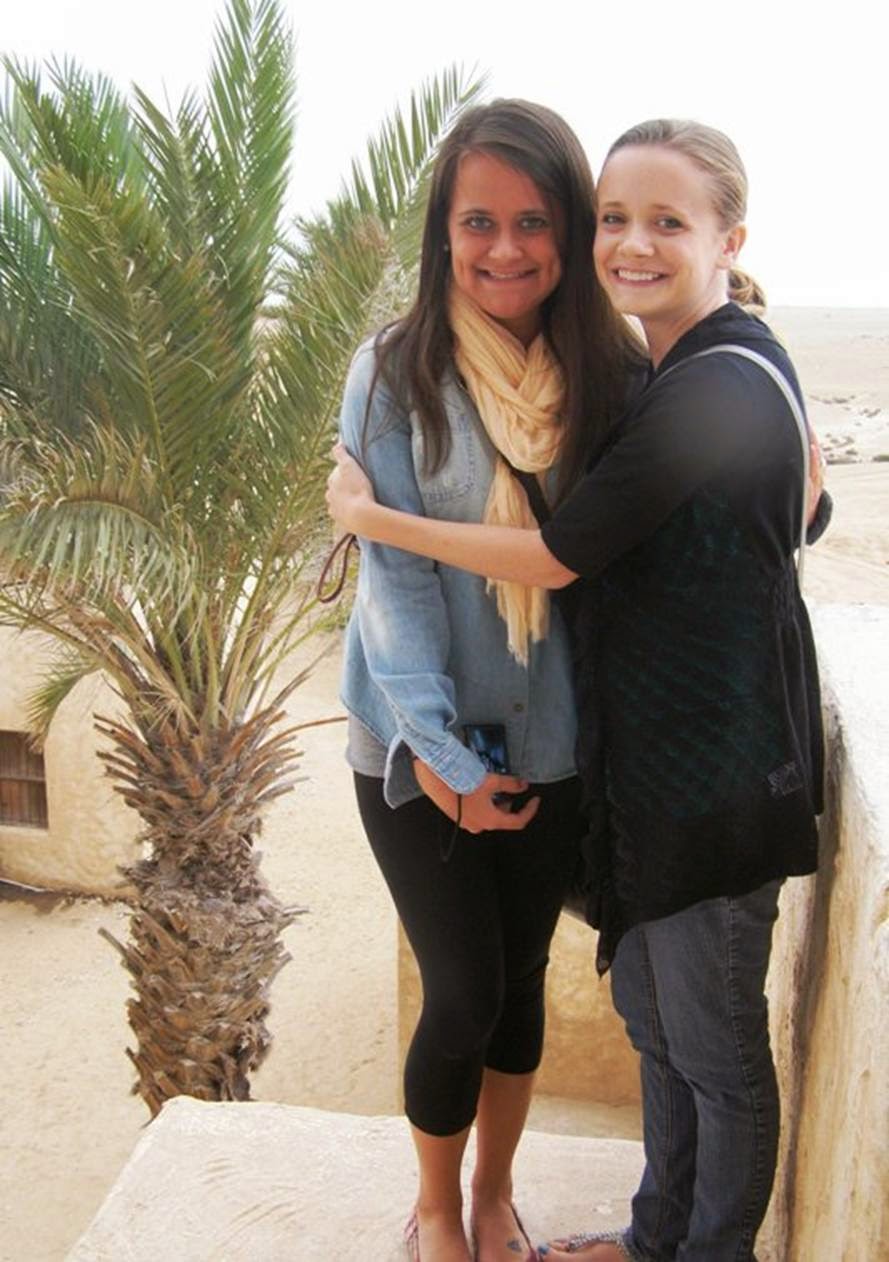
 
ma sha allah!
Katie and Kimber at Film City
 
Read about it:
 
Culture and Language
Six day work weeks and unrelenting traffic didn't leave much room for sightseeing. Still we managed to learn some Arabic and gain understanding of a sometimes mysterious culture.
 
Bob and Cindi meet Qatar's Peace and Love Guy
 
Read about it:
 
We leave Qatar now with quivers full and no regrets. Ready to love on our kids, grandkids, family and friends. Paint our kitchen, seed our lawn, plant a garden. And prepare for life's next great adventure.
 
 
yallah habibkum!
This is the end.
Journey over;
new tale begins.
 
Disclaimer:
The essays in this blog reflect our experiences while living in Doha, Qatar during a particular 39-month period. Qatar is a new and evolving country; today, street names, shops and restaurant locations change overnight, tomorrow the landscape may be different. We hope you'll gain a positive appreciation for Qatar's people, religion, culture and history through our experiences.
 
ma'a salaama
ciao
arrivederci
adios
auf wiedersehen
illa liqah
'bye now!

Friday, January 2, 2015

A Made Up Place

under-tenanted at The Pearl, 2014
 
"…the number of residents here will grow on average by 7.4 percent annually in the coming years, reaching 2.5 million by 2016…"
 
If you're among the thousands of new expats expected to relocate to Qatar in the years leading up to the 2022 World Cup, here are a few things you should know:
 
1. It's KAH-tur.
 
قطر
 
Not Cutter (US), KAH-TAH (Brit) kuh-TAR (everyone else).
 
There are three letters/sounds in the classical pronunciation of the country's name : qaaf (enunciated deep in the throat)/tah (with a concave tongue)/ray (rolling r).
 
Exception: in Qatari (KAH-ta-ree) dialect qaaf is pronounced with a soft gee, as in gas, so locals refer to their own country as GUH-tur.
 
this way to "the spa"
 
2. They are not Qatari.
 
There are somewhere around a whole lot of people living in Qatar - but only 1/3 of them are bonafide, card carrying Qatari nationals. Of the remaining 2/3, most are unskilled laborers from India and Nepal or service workers from Philippines. A small percentage of the larger population are from the US, Britain, Australia and other European nations. Even shopkeepers dressed in traditional thobe and ghutra at the brand-new-made-to-look-old Souk Waqif are from somewhere else.
 
Sure, Qataris are out and about. You'll see them in malls, feel your car shake as their Land Cruisers rush past, smell their oud in elevators. And, yes, Qataris work! Not every day or regular hours. They take a lot of vacations. You'll never meet a Qatari taking orders at McD's, working the DQ drive thru or answering phones at the Ramada. But still. Fresh out of school they claim top tier positions as government school teachers, administrators, CEOS and entrepreneurs (see #3, below). Qatari law requires that a local own a minimum 51% share of every business.
 
In Qatar, there are lots of layers between the larger population and nationals, even in independent business. Unless you come to Qatar as a nanny, maid, driver or clerk, hang around Fanar Islamic Cultural Institute, get into trouble or enjoy a busy night life (see #4 below) - you may never come to know a Qatari in Qatar.
 
3. Wasta. Bias. Traffic.
 
Wasta is nepotism without stigma; specially packaged bias in a place where employment, accommodation, financial perks and social rank are already determined by nationality and race. Where a high school graduate may be absorbed into university with low expectation and flung into a high level position without experience. It's a culturally approved professional track for the young and privileged when rules already preclude attendance at government funded university beyond age 40 and foreigners may be expelled once they reach age 60.
 
Hooray for traffic, the great equalizer. No amount of wasta exempts you, it doesn't matter where you're from, the color of your skin, language you speak or how old you are. Cars, trucks, vans, buses, Land Cruiser, Toyota loll bumper to fender; nationals and expats together in endless smoky lines, late for work and play; listening to Taylor Swift on CD, blaming them (see #2, above) for their troubles.
 
wasta in action?
photo courtesy Matt Mikus
visit Matt's travel blog: postcards and playlists
 
4. Not as conservative as you think.
 
If she's local, between the ages of 25 - 50 and dressed in abaya and hijab, she likely has a college degree. She's fluent in three languages, well read and considering a new business venture. Odds are, she's travelled the world, holds a driver's license, manages a busy household in a rapidly changing environment and works too. She's thoughtful and interesting and you'll never meet her. At least not in Qatar. (See #2, above.)
 
The face of Qatar is English speaking/educated abroad/thobe-wearing/wasta employed/under-30 year old, young men.
 
In Time Magazine, they stand stoically for photos before West Bay's whacky skyline. They're a vision in white at the Qatar Tennis Open (and other celebrity events).
 
In Qatar? They're hanging out of SUVs as they circle the camel race track. Flashing Lamborghini headlights in your rearview mirror. Swerving in and out of the everywhere traffic clog. Performing motorcycle tricks in intersections as multitudes of incidental spectators idle. Escorting falcons through the souk. Creating an impassible thobe-to-thobe chain along the Pearl's boardwalk. Sliding down dunes in $60,000 USD cars.
 
Nose tapping, laughing, hand holding. In restaurants, hotels, movie theaters and, yes, wearing Western clothes, in bars. (Traditional attire - and local ladies - not allowed.)
 
(highlight added)
 
White thobe and sandals, ghutra. Male traditional attire is legitimately worn by conservative Muslims of all nationalities as a humble religious gesture. It's worn by shopkeepers and other workers to provide ambience in the souk and at special events. But if it's after 3pm, he's under 30, heavily starched ghutra is tipped at a jaunty angle and other expats are stepping aside and/or changing lanes? He's probably local.
 
have-your-pic-taken-before-a-Bedouin-tent
Souk Waqif, 2014
 
5. A made up place.
 
Less than one hundred years ago, Qataris were pearl divers in the summer, Bedouin camel and sheep farmers in the winter. Locals lived in fabric tents and porous rock huts. All of which have long since dissolved into the landscape.
 
There are no pyramids, castles, ancient mosques in Qatar. Zubarah Fort wasn't built until 1938. There's no indoor snow skiing, walk-through aquarium or Burj Khalifa.
 
What Qatar does have is a rocky coastline, dunes, Sheikh Faisal. There is evidence of ancestral participation in the Orient's purple dye industry. Living people who remember (if you're fortunate enough to meet one; see #2 above).
 
And, oh yeah, money.
 
Damien Hurst's "Miraculous Journey"
Sidra Medical and Research Center, Doha

Thanks to oil and gas income, today's Qatar-in-the-making is a new money let's-build-something! playground produced by underpaid Asian laborers held captive by the Kefala sponsorship system. In which a worker relinquishes his dignity along with his passport.

As the country hasn't been industrialized long enough to provide its own architects, engineers and skilled workers, for its reinvention it must rely upon the talents of  foreign professionals. These educated, experienced, often pushing-60 individuals are paid to design and implement infrastructure, roads, stadium projects, a multi-billion dollar downtown, zoo and possibly the world's-longest-strip-mall - a shopping shell pocked with inaccessible-due-to-construction businesses.

Thanks to money, sand is processed, water desalinated. Humid, shimmering air is recycled so interior temperatures remain arctic even in the most eyebrow sizzling weather. Under-tenanted resorts exist in places that once belonged to the sea. Elaborately decorated mansion sized villas bloom in artificially enhanced areas that once couldn't sustain life. Homes feature his'n her majlis spaces where she sips tea and nibbles sweets with the ladies while he smokes sheesha and hangs with the guys.

Thanks to money, there are highways garnished with floral displays, modern automated billboards, plazas, parks, old malls, new malls, malls-to-be. But no tourists.
 
"…We don't want people to come for a $50 room to lie on the beach all day and walk around with a backpack and shorts. These are not the type of people we're targeting. We are different from the neighbouring countries. They focus on tourism as a source of income. If (the tourism market) crashes, it makes no difference for us…"
Qatar Tourism Authority's Ahmed Abdullah Al-Nuaimi,
Reuters, August 2011

In 2014 Doha, oil and gas funded high rises and hotels stand empty. Bored clerks check facebook and play games on phones. Laborers are paid to attend world class sporting events. Doha's version of the Big Red Bus, the cheerful green and yellow, double decker DohaBus, trundles empty from Lagoona Mall to the (under construction) National Library. At night, West Bay's skyline strobes above sporadically populated party lit dhows.
 
 
Thank goodness for money! Without it, today's Qatar just wouldn't…be.
 

Sunday, December 14, 2014

Talk Like An Egyptian

pic borrowed from the web
 
In the American Midwest tree branches are bare. Brown leaves litter streets and sidewalks, frost fogs windows. Crisp blades of frozen grass stand at attention. Breath puffs into the chilly air like clouds.
 
winter in the American Midwest
 
We start out on the couch, but end up cross-legged on the soft, carpeted floor. Books and notebooks whirlpool around us. "Do you want tea or coffee?" she says.
 
No, thank you, I say.
 
She shrugs. Okay.
 
A 6-foot wide tapestry from Kuwait adds a bright bit of color to the cozy earth tone space. There's a dining room table, piles of books. A cheerful, functional kitchen. A bathroom with a spray nozzle built into the toilet seat. With a dial to select level of water pressure and a button to initiate stream.
 
example of portable bidet
pic borrowed from the web
 
We laugh about it, this bit of Middle Eastern preference tucked into America's heartland. "It's cool and refreshing," she agrees. Her smile is bright. "But then you're wet."
 
She has a Ph.D. in law and taught university before moving from the Middle East to Kansas. Where she takes the kids to school, meets up with friends at Starbucks, cleans house, cooks dinner. She's fun, funny, comfortable and smart and she wears a colorful, friendly hijab. She's my colloquial Egyptian Arabic tutor.
 
harakat! I say. In written Arabic the word means movement and refers to those little dots and dashes that appear above and below the looping Arabic letters. In colloquial Qatari dialect it's how a teen might say cool! or awesome!
 
She laughs. "In Egyptian dialect you could say gamda aowee." Which translates to rigid a lot.
 
da soura gamda aowee
not rigid in Cairo, 1974
 
All Arabs read and write using the same letters. Written Arabic has grammar rules, tenses, form, structure and is called fusha (fooS-Ha). It is the language of the Koran, and considered the foundation from which all Arabic dialect is derived.
 
Perhaps you, too, can read and write Arabic. Perhaps there is opportunity to use what you've learned on the street and in alleyways. Where educated Arabs recognize the high form of their language, chuckle at your stilted speech and respond slowly and carefully (because you're obviously not a native speaker). Perhaps communication happens.
 
But not cultural appreciation, personal comprehension, empathy.
 
shiny flask
 
Empathy is what happens in Qatar's silver and mirror lined window-less majlis spaces far from the English speaking streets. Where hidden women insist, just as it was in Egypt 30 years ago, a guest must eat three sugary dates as is stated in the Koran. To be a good guest here one must sip both tea and coffee, nibble cheesy bread and cake. Language flows fast, like the women who sit close, hover and fuss. It seems there are rules for everything from greeting one another to seating assignments, touching and laughing.
 
As in fusha, guttural 'ein is pronounced deep in the throat and "khaaf" spits like a hissing cat. But "jeem," a letter which says its name in fusha, is pronounced "ya" and the letter "qaaf" sounds like "g" as in "gate." Here "ee" means "yes" and "abee" means "I want."
 
Qatar's dialect, like its society, attempts to remain close to Koranic fusha. Both are ordered, structured. And changing.
 
Egyptian children's stage show
performed at Doha's souk waqif, 2012
 
Egyptian dialect, on the other hand, is loose, easy, indulgent, fun. Words flow, structure transforms to suit the moment, sound bits mix, muddle and sing. Egyptian dialect is the language of colloquial Arabic tv, music, books. Cartoons, comic books, children's programming is often produced using Egyptian dialect too. In Egypt, unlike Qatar, people speak their own language in the shops, markets, businesses and on the street.
 
Here, "ah" or a close lipped "mmm" translates to "yes." It's perfectly polite to add "ya" to the front of a person's name in greeting and everyone is "habibi/habibti" (my sweet one). In Egyptian dialect, "jeem" is expressed as "g" in "gate" while "qaaf" is eliminated altogether. There are words like "bass," "kidda," and "mish" which pepper speech like "yeah" and "uh huh" in English and "aiza" means "I want."
 
Sure, there are rules and structure, but rules are meant to be broken, right? The language, like the people, is vibrant, relaxed, comfortable, forgiving.
 
And changing. Like Egyptian society, which has experienced much turmoil in recent years - I am told there is a movement in Egypt to return the language of the street…to fusha.
 
returning soon to Cairo?

Sunday, December 7, 2014

Treasure in the Sand (Not Oil)

desert rose
 
Qatar is known as the wealthiest country in the world, per capita. Here you'll find world class sporting events, resorts (under construction), stadiums (in the works), spas and restaurants (coming soon). Qatar is also surreal traffic, tower cranes, nepotism (wasta), prejudice, bias and pollution. Countrymen huddle behind 10 foot walls, no one, it seems, speaks the local language and there's no such thing as a Qatari restaurant.
 
seen in the desert
 
There are, however, remaining pockets of untouched earth. Where no one has marred the landscape with weird steel plates and called it "art," filled the sea with concrete or crumbled porous stone with trucks.
 
behind the wheel in Doha
 
To find this disappearing space you must venture far from the city's desalinated river of life. Past the tower cranes and thirsty trees, water and sand processing plants. Beyond Lagoona's zig zag buildings and West Bay's whacky high rises. Far from roads lined bumper to bumper with SUVs, rumbling concrete mixers, rebar loaded semis and the neon night where stars twinkle from party dhows that drift under strobing towers.
 
Here you'll find the under populated, plaster coated old neighborhoods of early Qatar.
 
(pic taken thru a dirty window)
 
Slide between the houses, majlis tents and mosques and aim for the desert. Continue to where the soft sand is a crisscrossed network of animal, foot and tire tracks. Where hills of porous rock slip into plains of earth and sky.
 
seen in the desert
 
When the only sign of civilization is the persistent trail of power lines and race camel farmers, search the sand for splotches of white sabkha salt flats and scattered amber disks.
 
Mary Anne, Ronita, Samantha, Cindi
desert rose hunting
 
This is the land of Qatar's desert roses.
 
 
"Desert Roses are found in areas of sabkha either lying on the surface or between the layers of wet and dry sand. These roses…are intricate, petal-like clusters of crystals, mostly composed of gypsum…"
Qatar Kaleidoscope, by Frances Gillespie
 
Desert Roses are not exclusive to Qatar; they're found in other hot, dry, sandy places, too, like Mexico, Morocco, Spain, Tunisia and Arizona. They are mineral formations, composed of gypsum (selenite) and barite, shaped when fine sand is trapped between mineral fibers and then crystallizes. Barite is the heavier mineral, while gypsum is more fragile and fibrous. A rose occurs when multiple discs adjoin at angles.
 
 
Gypsum roses are more commonly found in the Middle East, Southwest USA and Arizona. Barite roses are found in Oklahoma, England, Italy (and many other places). Because the mineral is softer, gypsum roses are more fragile appearing than barite roses.
 
Some believe the sharp but delicate objects have supernatural qualities that can neutralize bad energy, purify, heal.
 
"…Some of the inhabitants of the Sahara desert believe that what they call the 'Sand Rose' has an internal energy that is used for protection, prosperity and purification…"
 
In Qatar, the best formations are found in the desert's salt flats, deep in the heavy sand, where the earth is moist and cool. Dig carefully with gloved fingers and brushes to avoid nicking the sharp, but delicate leaves. The right locations yield an abundant supply of crystals.
 

"The (Qatar National Museum's)…striking design was inspired by the desert rose, an other-worldly mineral formation of crystallized sand found just beneath the desert's surface. The pavilion's sand-colored floors, walls and roofs resemble the sharp bladelike petals of the desert rose…"
 
In Qatar nothing is as it was. There are no more pearl divers. Salty sea water is desalinated, sand is processed, even the sun is filtered to assure arctic interiors as outside temperatures soar to somewhere between hell and death.
 
West Bay
 
Skyscrapers lord over a once vast expanse of camel spotted sand. Grocery stores feature potatoes from Australia, carrots from Philippines, apples from France and cheese from Lebanon. Qataris are a minority here - in fact, many expats have never met a local. Laborers, administrators, engineers, geologists, architects and the cable guy are flown in to mold and shape the environment to accommodate the Qatari vision.
 
It seems that nothing and no one is from Qatar.
 
 
Except (oil and) one rare and beautiful thing: the Qatari earth still shapes its own desert roses.
 
Ronita's desert treasure

Friday, October 24, 2014

Ballad of the Men in White

photo credit: this pic brazenly borrowed from the web
will be deleted if the blog ever goes public again
 
The rags to riches story is a tale as old as, well - sand. There's Oliver Twist; JK Rowling; con man Billy Ray Valentine (Eddie Murphy) in the 1983 movie Trading Places; Dubai; Qatar (click to read brief history and answers to commonly asked questions); Jed Clampett.
 
American actor, Buddy Ebsen, as Jed Clampett
photo credit: photo bucket, edtombell
 
As the patriarch of the popular American 1960s era tv show, The Beverly Hillbillies, Jed Clampett discovers oil on his rustic (ie, poverty stricken) mountain property. Together with Granny (Irene Ryan), Max Baer, Jr. and sweet, buxom Donna Douglas, Jed lits out for "Beverly Hills, Californee" where the family's lifestyle is dramatically altered by Jed's "crude" discovery. They now live in a spacious mansion with swimming pool and photogenic stairway instead of a one room log cabin. They hang with movie stars and shop for thousand dollar (USD) huntin' togs.
 
If you're unfamiliar with the show and its catchy 40 second musical introduction, grab a listen here: The Ballad of Jed Clampett.
 
Then read my loose lyrical rewrite, below.
 
Dhow festival 2012
local poses for photo wearing
traditional pearl diver attire, sort of
 
The Ballad of the Men in White
 
Come and listen to my story
'bout the men in white.
Once pearl divers sleeping
on the sand at night.
 
Then one day
as they were camping on a dune,
up come the Brits
with startling news.

About oil…
Black gold…
Texas tea…
 
First thing you know
these men are billionaires.
Slipping starchy scarves
over beards and hair.
 
Emir said,
"Our desert's the place to be!
For soccer, building, fun and
fast food KFC."

World Cup, ya'all…
Stadiums…
New downtown…
 
Today instead of dhow boats
there are high-rises and schools.
Foreigners from everywhere
breaking Muslim rules.
 
Clogging streets and malls
with their rude proclivities;
like eating pork, sipping scotch,
baring arms and knees.

Skin…
All colors…
Haraam…
 
Men in white aren't divers now.
They're wealthy businessmen.
Driving fast in SUV's,
hanging out with friends.
 
These multi lingual Western grads
watch American tv,
party on the dunes at night,
eat fast food KFC.

Rolex…
BMW…
Land Cruiser…
 
it says: Dajaaj Kentaacky, drive thru
The Colonel flies high over C-Ring Road
Doha 2014
 
This is a closed blog and unauthorized readers are prohibited. If you are offended by any content found herein, please cease reading immediately, notify me of your accidental consumption of my material and I will promptly remove your name from the list of approved readers. For your own protection, of course.

Friday, September 19, 2014

Waving a Smile, Making a Connection

Bob and I walked the Pearl. He wore a tee shirt and to-the-knee shorts, just as he might stateside. I wore shin length, sweat wicking capris with a hip shielding tee shirt. No shoulder revealing tank tops or visible running bra for me; nope. No thigh high Nike jogging pants; uh-uh. Even as we sped, arms swinging, past strolling expats in spaghetti straps and tight dresses. As more of Qatar's expat women toss aside scarves and modest attire, I persist in covering up.
 
Why, you ask? Because the Qataris asked me - and everyone else - to:
 
Please cover from shoulders to knees.
 
At 7:30pm lights across the bay twinkled, a party like reflection in the mirror smooth water. Brisk air temps not quite 100F; this is fall in Qatar. Still, 57% humidity and no wind translates to sweat drenched tee shirts and capris so heavy I tugged through my tee shirt to keep them at my waist.
 
Droopy drawers at ankles might not be modest, even if they were capris.
 
A golf cart swept past us. My eyes met the dark, mascara and pencil-lined orbs of one of two teen/young adult-ish girls. Both covered top to toe in abaya and sheyla, faces visible. They took up the two seat space at the back of the cart, facing the direction from which they'd come.
 
The young girl smiled at me; I smiled back. Her smile got bigger, so mine did too. I raised my arm and waved, and she waved back.
 
"Do you know them?" Bob said.
 
"No." And I thought:
 
Perhaps there isn't true freedom of speech in Qatar. Perhaps the ladies don't return my emails or phone calls. Perhaps I've worked hard to learn a language I'll never speak - in Qatar, at least. Perhaps all my efforts to get to know the people and culture were for nothing. Perhaps. Still, this beautiful (ma sha allah) young woman is smiling and waving and HEY, here's a connection!
 
The cart was speeding away fast and so was she, so I straightened my elbow and waved a half circle smile at her…which she returned.
 
"Why is she waving at you?" Bob said.
 
I shrugged. "Just like Western women like me are curious about the Middle Eastern ladies…I guess they're curious about us too."
 
Thanks to the abaya - and distance and dark - I'd never know her if I saw her again. Still, the exchange made me feel good. Like maybe I should keep writing? Even if it's no longer public. Even if there are no more hits from curious strangers living in places all over the globe. Even if it's just for me (and my mom and dad).
 
Even if.

Friday, August 15, 2014

How Qataris Kiss

"Mr. Q" is a Qatari who writes a video blog for iloveqatar.net. One his most popular pieces is called "Q Tips" where he offers bite sized information about Qatari customs and traditions:


I hope you'll enjoy this fun peek into Qatari life as much as I do.

Want to know more?

Read Mr. Q's blog: http://blog.iloveqatar.net/
View more Q Tips here: QTips

Friday, July 11, 2014

Minding My P's and Q's

beautiful, energetic, my mama
 
She's dynamite in white: pants, shirt, shoes, socks. Even her mop of curly hair is iced in frosty hues.
 
Multi lingual army brat, homecoming queen, degreed. She's a busy professional who operates her own business, jogs, lifts weights, writes. A stranger once stopped her on the street to rave over her multi colored aura but you don't have to read it to see it: energy shoots from her eyes, radiates off her skin, envelopes friends and others. She's a light in the darkness, a campfire on a cold night, a rocket soaring through the sky.
 
"We travelled from California to Missouri and all along the way people offered me their seat," she laments. "As if I were old."
 
I suggest the deference wasn't due to incorrectly assessed infirmity but because she's a woman, professional, of a certain age and worthy of respect. She rolls her eyes.
 
"Did you take the seat?" I ask.
 
She nods, smiles. " Yes, of course."
 
respect your elders, youngun
(Katie and her grandpapa)
 
My mama taught me this: say please and thank you, excuse me, yes, ma'am, no, sir. Don't play your music too loud, do offer your seat, flush. These universal niceties are one's P's and Q's and apply no matter where you are in the world…plus a few more:
 
In Qatar
 
Adherence to the cultural expectation of modesty is considered good manners and respectful too. Plus, when supping from a communal dish one should use the three fingers on the right hand, eat from the area nearest you, don't blow on your food. Hold the door and stand so that others enter first, to your right. An older-than-you female relative or stranger is called "aunt" or her kunya is used to address her. Adult women refer to young girls as "Mahmah" to bestow a kind of pre-respect. Deference is shown to a man with the title "uncle."
 
But, wait, there's more:
 
"…I go to the ground floor of our house and my children rush to kiss my head…I start by greeting 'Al-Salam Alaikum wa Rahmat Allah wa Barakatuh', and try to find my mother. I kiss her on the head, then do the same for my father. My siblings and nieces/nephews would be queuing to kiss my head…"
 
That's right, older family members - and senior strangers within the culture - receive kisses to the top of heads from younger others. It's respectful, deferential and expected.
 
Doha billboard
be respectful: don't spit!
 
In Philippines
 
Unofficially Filipinos comprise the second largest expat population in Qatar (after Indians). They are nannies and maids, clerks, administrative assistants, receptionists, drivers, mechanics, nurses, doctors and more.
 
"If Filipinos left Qatar, everything would come to a screeching halt."
- commonly heard (in country)
 
Some young Filipina mothers don't see their children for years as adults often leave home to provide for the family. Most come to Qatar alone, leaving children behind with grandma. It's no surprise that Filipino families are very close, with a strong, culturally imbued respect for elders.
 
"…conservative families expect children to practice the kissing of hands or placing their parents or elder family members' hand to their foreheads with the words 'mano po'…"
 
Remember to say please and thank you and press the back of auntie's hand to your forehead.
 
In America
 
 
Lush groves, rattling trucks and hog sized motorcycles with riders in camo doo-rags. Someone's mama drives a rusted Buick which passes an Amish buggy on a highway flanked by fields of corn, clover and Queen Anne's lace. Where just-folks wave to strangers, the American flag unfurls over the quik mart and the downtown McDonalds does a brisk noon business.
 
The highway between Springfield and Kansas City: the heart of America's heartland.
 
I pull into an empty parking space, step across the busy drive-through lane. In front of me swagger two teenage boys in CAT caps, baggy jeans, black tee shirts and scuffed, untied tennis shoes.
 
One boy pauses at the door. He holds it and stands so I might enter first, to his right. "After you, ma'am."
 
My heart swells with pride for his mama.
 
"R-E-S-P-E-C-T find out what it means to me…"
-Aretha Franklin, "Respect"

Friday, March 7, 2014

W'Allahee! Ten Arabic Phrases

BMD Wives and babies smiling in Doha, March 2014
Photo credit: Kari Viet
 
"Your smile…is a charity."
-Prophet Muhammad (PBUH)
 
Most Arabic speakers won't be bothered if you call a man "habibtee" or refer to that important organ in a person's chest as a "dog" (kelb) instead of a "heart" (qalb). Which doesn't mean they won't laugh at your mistake! To keep the hilarity to a minimum, I've put together a list of ten common Arabic phrases and how to use them (along with random photos from our week in Doha).
 
First, a couple things: 
  • Allah means God.
  • salaam means peace.
  • There are no capital letters in Arabic, so I've used lower case for phonetically spelled Arabic words.
  • Some literal meanings don't match usage when translated to English. Don't try to understand the "why" - just go with it.
  • What's rude in one context may be funny in another. And what's polite may be insulting when uttered with the right/wrong inflection.
  • To attain this information: I (studied the language, participated in conversation and) asked Arabic speaking Arabs (to explain why they were laughing).
 
Qatar National Theater
all lit up for a
Thai cultural event
w'allahee!  والله
 
"This word, it is swearing," she said.

"w'allahee, it is not," said another. "It is for emphasis, when something is
true and right."

"It is overused," she said, crossing her arms.

Similar to, "By God…" in English. As a way to emphasize the correctness of something by pointing out that a thing is fundamentally so true, you say it here right here, right now, in God's presence.
 
But nowadays it's often used (along with the shorthand version, w'allah) to mean: OMG.
 
Inside the Qatar National Theater
 
ya habibee/habibteeيا حبيبتي   /  يا حبيبي
 
Adding "ya" is like saying "hey!" but in a personal way: "ya Mom!" or "ya daughter!" when you want to stress something or get the attention of someone you know. It's NOT appropriate to use "ya" to refer to a general acquaintance. "ya Boss!" might be considered rude, for example.
 
habibee means "my sweetheart" when referring to a man; habibtee when your darling is a woman. "ya habibtee, I love you like Blue Bunny Chunky Chocolate Chip Ice Cream."
 
In Arabic slang, ya habibee is also used like "hey" or "man" (California) or "ya'all" (Missouri, Mississippi) as emphasis or to reference a friend: "Hey, ya habibtee, ya'all want some more tea?" or "ya habibee, man, it's hot in Doha."
 
ya salaam!  !يا سلام
 
Literally translates to "Hey, peace!" But before you go all 60s America: this phrase is used to express surprise. (More polite than w'allahee.)

You: "I bought you a car!"
Me: "ya salaam!"

Inside the theater space
Qatar National Theater, Doha

in sha' allah  ان شاء الله

I made plans; God laughed
-famous saying

in sha' allah means "God Willing" and is used when making future plans. Dinner reservations, haircut appointments, business meetings, arrival times, departure dates, a child's bedtime. It's a way to succinctly defer to God in everything, whether choosing a lifetime partner or having spaghetti for dinner.

It's true that time doesn't mean the same thing in the East as it does in the West but use of in sha' allah does NOT mean the person you've invited to tea is looking for a way out of meeting with you. There are more important things than being on time for a business meeting: Mom, for example. A wait of 15, 30, 45 minutes for an appointment isn't considered "late" - just…divine intervention.
  
It's like saying: "I will enjoy Halloumi cheese with you at Zaatar w Zeit at 6pm Tuesday - unless I'm hit by a bus while walking to my car because the Corniche is closed again, traffic is a horror and only God knows the day or time."
 
But shorter and nicer.
 
lahda low samaht, stanna shwaya  Arabic without words:
 
use right hand,
squeeze fingers to thumb, palm up, arm out:
wait, please
 
Attempting to merge in traffic? Someone wants your attention but you're on the phone? Can't find your credit card at Carrefour (the Middle Eastern Walmart) while standing at the front of a long line? Wife attempting a photo op while you're otherwise occupied? No sentence structuring needed as this handy "phrase" crosses language barriers.
 
ma sha' allah  ما شاء الله
 
"I love your dress! ma sha' allah."
"Your baby is beautiful, ma sha' allah."
"The machboos (rice and lamb dish) is delicious, ma sha' allah."

Should be included after any statement that acknowledges a person's talents, gifts, beauty - ie, any special human-generated something. As a way to recognize that everything comes from God, avoid jealousy on the part of the complimenter - and to assure that the aforementioned-wonderful isn't taken away.
 
That pretty face, nice car, beautifully appointed home is yours via heavenly favor only; and any gifts recognized without acknowledgment are subject to removal.
 
The person offering the compliment holds responsibility for including ma sha' allah. If the phrase is forgotten, don't be surprised if the person receiving the gift of words quietly says it.
 
Thai veggie carving at the QNT, ma sha' allah
I see this on your Thanksgiving table, Kay Hedrick…
 
subHan allah  سبحان الله
 
Like ma sha' allah without the avoiding jealousy bit - but bigger…much bigger.
 
This phrase is used to marvel with appropriate thanksgiving at the wonders that could only be created by God:
 
"subHan allah, the sunset is beautiful."

 
carving a bouquet out of a watermelon
Wow!
 
al humdu il allah  الحمد الله
 
Praise the Lord and Bless Your Heart; We Made it to Tomorrow.
 
Dots conversation, lights interactions, stands alone, simmers between, melts hearts, defuses situations. It's heard in business, pleasure, between enemies and friends. It means "praise God" and is used in conversation, in reply, by itself, everywhere, anywhere:
 
"How are you?"

"al humdu il allah!" (even if you're living on the street, kids are sick, dog has the flu).

"I won the race, al humdu il allah."

"I lost the race, al humdu il allah" (I'm strong and healthy, didn't fall and break a leg.
Or, my leg didn't fall off. Or, I still have one leg remaining…).

The idea is appreciation of the good over simmering in a muddle of the not-so-great, dragging others into the morass with you. Look first at you've got without dwelling on what you don't have.
 
Which doesn't mean a person won't come clean about her cancer diagnosis when asked directly by a well-meaning friend. One first gives thanks for the blessing that is this moment before slipping into the down and dirty facts of life. Gratefulness is polite, expected. Plus, God is listening.
 
If I gave you a Toyota would you say Thank You? Or kick the tires and demand a Ferrari? And if you weren't grateful, how likely is it you'd be receiving any more gifts from me? If you believe that life itself is a gift from God, you'd say thank you, too, before putting that Toyota on Craig's List.
 
cultural juxtaposition inside QNT:
majlis space, dhow, bukhoor, coffee pot
traditional Thai dress, Thai music
 
shukran شكرا   and jazaak allah kheer  جزاك الله خير
 
shukran means "thank you."
 
jazak allah kheer means "thank you" while also bestowing a blessing upon the thankee.
 
Both are acceptable. Qataris prefer jazaak (jazaach when speaking to a woman) allah kheer.
 
QNT balcony overlooking Corniche and Bay
lights, traffic, palm trees, tiny Fanar
 
salaam 'alaykumسلام عليكم     
wo 'alaykum assalaam و عليكم السلام 

"…The Prophet (Peace be upon him) said: 'Greet with Peace those whom you know and those whom you do not know'…"
 
"Peace upon you," I said.
"And upon you, peace," she replied.

It's true that some conservative religious believe this special greeting and its response belong only to Muslims. In my experience, the wish of peace is given and returned freely, especially when it's accompanied by a smile.
 
BMD Dawn snuggles two gorgeous BMD babies
 
"All We are Saying is Give Peace a Chance."
-John Lennon