Showing posts with label Muslims. Show all posts

Friday, January 30, 2015

Ma'a Salaama, Doha: No Regrets

Dashboard entertainment:

yes, this really happened
at 80km/hr
But first, this happened:

Landcruiser idled in traffic
driver's door open
errant youth chastised;
traffic waited
without honking horns
even though the light was green
 
Sure, driving in Doha is hazardous. Living in Qatar is like residing on a construction site surrounded by a construction site within a construction site bordered by a yacht-and-dhow-sprinkled moat overrun with princes.
 
Abandoned buildings disintegrate in the wind and sun. Roads are rerouted to accommodate construction needs. Appointments, schedules, contract dates and terms-set-in-stone are fluid. No mail service. Empty grocery shelves, the metric system. Familiar, brand name products - made for an international market - taste or work differently. Services are discontinued without notice. Wet summer air puddles under thresholds, teases body moisture into clothes. Salty water stings eyes, dries skin. Rules about alcohol, behavior, attire. A mysterious, minority host culture. Prejudice, bias, wasta. 
 
And, yeah, traffic.
 
a different kind of traffic picture:
bare road plus
parked, red lakhiwiyya police SUV...
black sedan, tinted window
convoy
headed your way
 
But life in Doha is not all teenage boys, plugged intersections, rebar and concrete. For example, there is year round sunshine. Seasonal pink flamingos, the souk. Gucci, Hermes, Giorgio Armani. Porsche and Lamborghini. Tennis, handball, camel racing, the Call to Prayer, cute baby giraffes.
 
the Doha Zoo remains closed
this is what it looks like when you drive in unannounced
while the guard is on break
(then charm your way out in pigeon Arabic)
 
Less than 100 years ago, Qatar was a vast expanse of sand. Today there are flowers and malls. Date palms hem a brick Corniche around a glittering Bay. An eccentric high rise skyline ponies up nighttime bling. The country's National Museum (under construction) is uniquely shaped like a Desert Rose. Three short years ago stereo speakers fixed in The Pearl's trees broadcast bird calls. Today real birds flutter in the fronds.
 
behind the walls
a community park
Shehanniyah
 
Growing pains feature in Qatar's dunes-to-mansions story. But rapid growth is the tale's hero - and villain. Now, as we leave the desert behind, we choose to focus on the experiences that made our time here memorable.
 
racing camels and trainer
 
camel jockey
once upon a time small children filled this role
today's jockeys are politically correct
monkey shaped robots
 
The People
Coworkers, desert strangers, locals, teachers, friends. Qatari women who invited me into their homes, shared cultural secrets and personal stories. Bob's golf buddies and the international team at Weill Cornell Medical College's Standardized Patient Program. More profiles than time to write.
 
Niqab and glasses
Read about it:
 
Places
Deserts, beaches, resorts, churches, castles, pubs, B&Bs, spas. Ten countries, many cities. Exploring sand and rock from one end of the peninsula to the next.
 
Chris meets Corniche pearl
 
Read about it:
 
Time Together
A three year Qatari honeymoon. Opportunity to show our kids the world. Friday walks, trips to the desert, touring the Irish countryside in a Beemer.
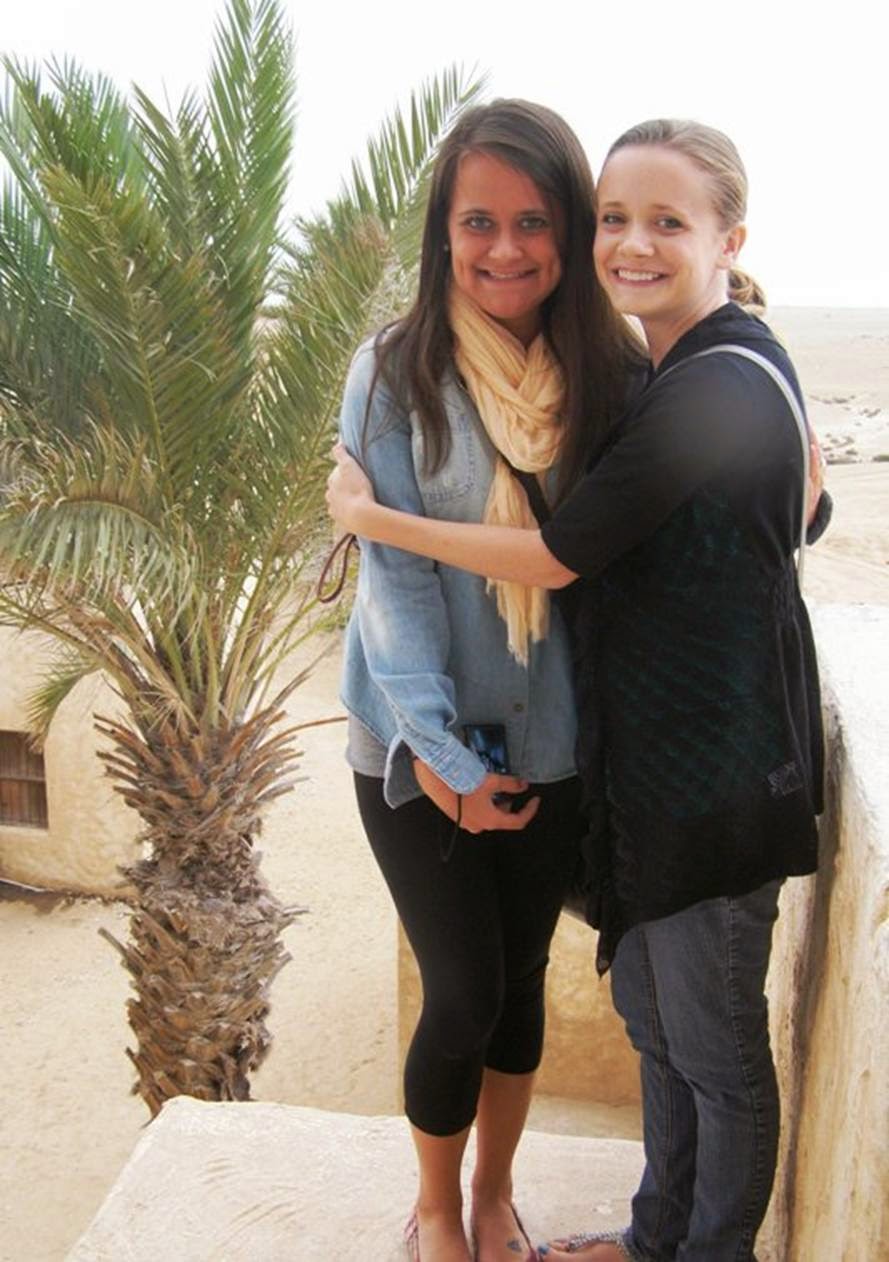
 
ma sha allah!
Katie and Kimber at Film City
 
Read about it:
 
Culture and Language
Six day work weeks and unrelenting traffic didn't leave much room for sightseeing. Still we managed to learn some Arabic and gain understanding of a sometimes mysterious culture.
 
Bob and Cindi meet Qatar's Peace and Love Guy
 
Read about it:
 
We leave Qatar now with quivers full and no regrets. Ready to love on our kids, grandkids, family and friends. Paint our kitchen, seed our lawn, plant a garden. And prepare for life's next great adventure.
 
 
yallah habibkum!
This is the end.
Journey over;
new tale begins.
 
Disclaimer:
The essays in this blog reflect our experiences while living in Doha, Qatar during a particular 39-month period. Qatar is a new and evolving country; today, street names, shops and restaurant locations change overnight, tomorrow the landscape may be different. We hope you'll gain a positive appreciation for Qatar's people, religion, culture and history through our experiences.
 
ma'a salaama
ciao
arrivederci
adios
auf wiedersehen
illa liqah
'bye now!

Friday, October 17, 2014

Baseball and Abayas

Bob, Kyle, Brad, Matt, Dawn (with little Mikus on deck), Aaron
celebrate the home team's ALCS victory 3am in Doha
photo credit: Matt Mikus (read Matt's travel blog: postcards and playlists)
 
Thousands of miles away and across the road too, the rest of my world celebrated the Kansas City Royals baseball ALCS victory and qualification for World Series competition.
 
Go Royals
 
I slid into abaya and hijab to attend Arabic classes at someplace new.
 
Maryam Center "Markazy Maryam" offers courses in Arabic, Quran and Islam
to Muslim women
 
The villa was surrounded by a high wall and tucked into a quiet community near a mosque. In front of the wall, a man guarded the sandy street. Behind the modesty-protecting barrier, shrouded women slipped through a paper covered door.
 
sorry, guys
 
Inside, black garbed women circled a stairwell. Windows covered in stained glass muted the hot sun. Like everywhere interior Doha, the air conditioning was set to "arctic" and the chill raised goose bumps on my blanketed skin. Three ladies worked at computers as dark eyed women rustled in and out of quiet rooms. In a windowless office, a lone woman sat at a mahogany desk, her title etched in Arabic on a wooden nameplate.
 
A brief consultation and the mudiera left the room. When she returned, she said: "Our classes are for women who are already Muslim. But you are so," here she supplied an Arabic word that she explained meant you-seem-Muslim, but might also refer to the preacher kid in me, ie, perhaps-your-dad-was-a-pastor-and-your-mom-a-church-pianist.
 
She handed me a registration packet. "I told him I wanted to give you a chance."
 
"Him" (no, not God): the unseen man who maintains unilateral authority
no matter how grand the boss-lady's desk.
 
For three years I've participated in the Arabic program at Fanar, the upside down ice cream cone minaret lighthouse-for-God at the center of downtown Doha. After a three month summer hiatus, one other woman and myself were ready to begin the final session of Fanar's five level program. That's when everything changed: new leadership, teachers fired, upper level courses moved from mornings to evenings. And new rules: we needed three more students before our class would be scheduled.
 
My classmate, a busy young Muslim mother and French expat, chose to go on to other things. I determined to follow our previous instructor to her new teaching position at Markazy Maryam.
 
abaya and hijab required
 
Here's what it's like to climb stairs carrying a purse and book bag as a newbie in abaya and hijab: sheer fabric clings to jeans, tangles at knees like a bed sheet to pajamas and (especially if it's front snapping) the robe flaps open. You instinctively release the handful of material gripped to prevent abaya from dragging as the skirt extends beyond shoes. Muted hallway sounds increase as you flail at the fly-a-way robe. Meanwhile, hijab slides off ears, slips over face. Disoriented and off balance, you, too, might shuffle over the abaya's hem, drop purse, trip over bag, turn the wrong direction and, blinded by a scarf, face plant.
 
Other activities, like the aerobic event that is the Arab greeting, maneuvering into a student desk or using the bathroom will be left to your imagination.
 
My teacher did not immediately know me with my sun-bleached hair and western attire hidden. Upon recognition she wrapped me in her arms and joyfully praised God.
 
"No, I'm not Muslim," I whispered in her ear as that's where my mouth was at the time. "I'm here for your class."
 
She squeezed me tighter. She kissed my cheeks and introduced me.
 
 
I settled into a front row seat and, along with six other ladies in black, learned about 3, 4 and 5 letter past tense root verbs using examples from the Quran.
 
foretelling baseball future?
Christmas Day Dhow ride, 2012
Go, Royals!

Friday, August 8, 2014

Is Qatar Safe?

 
The second most common question we're asked (after Qatar? Where's that?):
 
Is it safe?
 
After all, battle lights from Saudi Arabia, Syria, Iraq, Iran and Afghanistan sparkle over Qatar like a halo. The Taliban Five are housed here, those guys the US President controversially freed in exchange for a single American Marine. The five live in our resort "neighborhood," purportedly housed in a guarded, castle-like compound at The Pearl.
 
no matter your size, there's a thobe for you
display at The Pearl
 
The single land route out of Qatar is through Saudi Arabia. Permission to make the trip requires months of paperwork and is usually only given to drive straight through. A woman must be accompanied by her mahram and covered head to toe, even in the car.
 
There is the questionable treatment of migrant workers, Matthew and Grace Hwang, the unending parade of waste water trucks that disappear into the desert and return stocked with "potable liquid."
 
Plus, they wear thobes and abayas in Qatar, live behind forbidding ten foot walls, speak Arabic. And they're Muslim!
 
 
While it's true that there are cultural and ideological differences that sometimes cause conflict, if you read my blog, you already know that Islam is a peaceful religion. And Qataris are, in a quiet, non attention seeking way - Peacemakers.
 
the Peace and Love Guy dances on his truck
in front of the Amiri Diwan
 
In Egypt, Israel, Palestine, Syria and with the Taliban (who, it's said, have offices in Doha) Qatari leadership quietly broker discussions to further peaceful resolutions to end the cycles of violence. In taking the Taliban Five off the road, after the US President negotiated their release, Qatar assures the men's physical non-involvement in conflict. As the first Middle Eastern country to host the World Cup (in 2022, in case you've been living under a rock), they're breaking new ground in communication and understanding.
 
Qatar has opened its doors to an expat majority who don't dress, look, eat, play, worship - and sometimes don't even respect - their culture, religion and way of life. Yet, before the roads, water lines and electrical networks had traversed the peninsula, there was McDonalds, Dairy Queen, Chili's and TGI Friday's. A new modern mall goes in, it seems, every week.
 
There are Christian churches in Doha. And, even though it's haraam in Islam there is a liquor store that sells pork.
 
 
Sure, we feel welcome. But do we feel safe? We respect the culture, follow the rules, keep a low profile. And, yes, we feel safe.
 
giant pitcher on the Corniche
hospitality symbol
 
More safe than I feel right now, in fact, sleeping in my bed in America under a US government owned, 40 foot tall, 12 foot diameter dead tree. Paperwork, photos and bids have long been submitted requesting removal of the tree. Meanwhile, its 20 foot partner recently fell, taking out a neighbor's back fence.
 
 
Please Mister President, cut down your tree so that I might return to the Middle East where I will feel safe.

Sunday, June 22, 2014

Najla**

Two beautiful Western women on red couches,
ma sha allah!
 
The room is full of chattering Western women in jeans, skirts and tee shirts. They sit on red and black cushions placed in rows on the floor, facing a wall sized screen where two Asian men with beards huddle over a computer and projector.
 
In a corner, a shrouded figure stands quietly against the wall. Of course it's a "she" - a black scarf is draped over her head and face. The sheer fabric shields her features, hides the curve of her shoulders, neck and chest, until it meets her abaya which conceals the rest of her from arms to toes. She is silent behind the veil, calm, unmoving. I have to look twice to realize she's a person and not part of the wall.
 
 
I search for the shadow behind the curtain. I smile. "Salaam alaykum."
 
"Wo alaykum salaam," a voice whispers. She chuckles and I know her. I say her name with a question mark. We hug.
 
She's not separated herself from me; I know this. She's stepped away because there are men in the room and her traditional interpretation of Islamic principles inhibits interaction of any kind between non mahram men and women. The covering is one expression of her conservative Islamic beliefs.
 
A woman's mahram is a person whom she is never permitted to marry because of their close blood relationship (such as her father, grandfather, great-grandfather, etc., and her son, grandson, great-grandson, etc., her paternal and maternal uncles, her brother, brother's son and sister's son)…
 
I feel the curiosity in the room, hear the whispers as women peek at her and wonder to each other: Who is she? Why is she hidden? Doesn't she want to be free? Who told her she had to cover herself?
 
Of course she knows what they're saying. She understands the discomfort and confusion and isn't bothered or offended. Her job is to teach, explain, enlighten Qatar's female visitors. Her mission is to share Islam.
 
 
I want to go from person to person and introduce this amazing, bright, enthusiastic, intelligent woman no one can see. I want to tell them how she's a diplomat's daughter who's travelled all over the world and speaks three languages. She has a university degree. She's an accomplished presenter and writer who is happily, joyfully married to a man she adores. She's fun, funny and smart. She has a large, loving, welcoming family who, if you were fortunate to visit in their home, would ply you with sweets, coffee and tea. They would intervene when your daughter is asked if she'd consider marriage to a local man ("she's focused on her studies at this time") - and send you home with a bag brimming with chocolate.
 
I want to tell them to look beyond the veil and the differences it represents.
 
But instead I find a spot against the wall, sit.
 
After the men leave it's just us girls. The veil comes off and personality takes its place. Questions are answered. She is a warm and welcoming representative of her country and culture as well as a bridge to understanding both Qatar and Islam.
 
Curious? No need to whisper. All you gotta do is smile and say hello.
 
**Not her real name, of course.
 
 
Yes, my blog is late this week. Thank you to everyone who wrote to let me know! I'm spending the summer stateside where I will be very busy jogging in the street, working in my green, green garden, fixing my house, eating Chipotle and watching Big Bang Theory with my beautiful (ma sha allah) children. Plus and especially, loving on the two most wondrous grandbabies God ever made (ma sha allah!). As such, my blogging schedule may be less routine - and more eclectic - than usual. Thanks for reading!
 

Friday, June 13, 2014

How to Read Arabic: Four Easy Steps

Arabic Calligraphy made out of Arabic Calligraphy
 
It was a simple list of Arabic words, neatly typed in easy to read font, evenly spaced and aligned in a column. "What does it say?" said my friend.
 
I recognized letters, identified familiar words, comprehended general meaning. But understanding shrouded itself in my mind like a fortress sealed for battle. I returned the page in defeat.
 
"That's okay." She shrugged. "I'll ask someone else."
 
Ouch.
 
As I see it, there are four steps to reading Arabic:
 
1) Identify letters.
 
The language does not utilize capitals or "cursive," but there are three shapes for each of Arabic's 28 letters, plus vowel markings, dots and sometimes dashes. There's stylized and sloppy writing, contracted spelling, stacking, dropped dots, added curls, lines, circles, hooks.
 
two ways to write Daad
 
And there's Arabic calligraphy with its flourishes, lines, circles, vowel markings and decorative symbols:
 
this says: "Al Jazeera"
 
الجزيرة
this says "Al Jazeera" too
 
Reading Arabic is often a rousing game of "Where's Waldo" but with letters instead of people.
 
2) Read the word.
 
Congratulations, you've located the letters! Now you're in a position to make sounds. In English this is the part where your index finger hovers over diphthongs, blends, consonants, vowels. Is the sound long or short, hard or soft, speak its name or remain silent?
 
Reading in Arabic requires the same step, only without vowels, which, by the way, do not commonly appear in the everyday literary Middle East scene - ie, newspapers, street signs, television commercials, correspondence, textbooks, event flyers.
 
"(Vowels) are for babies," said Teacher. "You will understand from context."
 
Kitty likes her harakat (those squiggles over the letters: vowels)
"Kitten," from an idea by Andrea Dami, illustrations by Tony Wolf, Text by Silvia D'Achille

Oh yeah, you're expected to elucidate vowels when reading. It's just that they're not provided (once you graduate from board books).

3) Comprehend meaning (of individual words).
 
Way to go! You've identified letters and applied sound. Now you may translate.
 
Only…factoring in the million or so Arabic dialects, Koranic use, invisible vowels and what happens to meaning when you add "the," conjunctions, prepositions or adjectives…each word in Arabic has approximately 400 different definitions. (I might be exaggerating but only slightly.) Some meanings are literal and unique like, for example, this word:
 
شعر
 
which may mean poetry, to feel - or hair - depending upon where your mind applies that missing vowel.
 
اشعر الشعر و الشعر.
 
I feel poetry and hair.
 
Other meanings are less literal, like this word:
 
فكر
 
which is pronounced "fakkr" (yes I know what it sounds like in English) and means, generally, "to think" (along with variations on the theme like "contemplate, idea, intellect, consider…")
 
(When a different invisible vowel is applied) this combination of letters also refers to a prayerful thinking-on-God activity called "fikr" where observant Muslims caress prayer beads and speak God's name over and over. This form of contemplation results in heavenly reward.
 
prayer beads
 
"One minute of fikr is equivalent to a year of worship, and one hour of fikr competes with 60 years of worship."
 
4) Understand.
 
You've found the letters, recognized words and have a general idea as to meaning. Now, relax. Drink tea. Release understanding into your mind in the way that steam floats from a mug of sweet Arabic coffee to warm cold fingers on a snowy day.
 
Snow in Egypt, 2013
 
At least that's the idea.
 
words shaped like a flower
 
Hours later, long after my friend and I had gone our separate ways, understanding danced in my head like rain over the Sahara: too late.
 
Arabic isn't just nouns, verbs, adjectives (and a bunch of other things that don't translate). It's more like an orchestra of colloquialisms strung together by sound. You don't translate as much as absorb the secrets in the melody and rejoice in the harmony of understanding.
 
But first, you must locate the letters, drink tea - and wait.
 

Friday, June 6, 2014

Machbous, Prayer and God

Each guest received a laminated cookbook
 
The voice echoed pure, smooth, clear off stone walls and tile floors, sailed into the glass dome that fed light into the majlis space, filled every corner of the larger-than-my-apartment rectangular shaped room. Full, rich, angelic. Trills over a monotone, alto to soprano, singing but not.
 
More than 50 women from France, Germany, Spain and other countries settled into couches along the walls. Voices quieted. Movement ceased. Conversation ended. The only sound was the smooth, honey textured voice.
 
A rustle hummed beneath the melody, just a whisper. I searched the room for a microphone or stereo, but there wasn't one. All eyes seemed to be focused on the high arched entryway, just outside my field of vision.
 
We'd been invited to attend a presentation about prayer and Ramadan offered by the Qatari Women's Association (QWA) for ladies from organizations throughout Doha. I'm not a member of any group, but learned about the program through a Qatari friend.
 
ready to learn about Ramadan and prayer
 
I emailed interest and provided the name of our inviter. I received a map to our host's home: a walled villa the approximate size of a city block located just outside town.
 
The gate was ajar. Inside, a freshly dug garden surrounded a wide covered porch and concrete patio. Thobe-wearing little boys with skateboards scattered as we approached. We climbed the stoop, pushed the glass door, stepped over the threshold.
 
Inside, a group of Qatari ladies dressed casually in jelabiya, suits and dresses circled a wide entry. Thick rugs were placed neatly over tile under a high ceiling. Warm arms enveloped us, pulled us close for hugs and kisses and passed us from one woman to the next. How are you? Where are you from? We're happy you're here, welcome, welcome! Please sit, would you like something to drink?
 
We twisted, turned, hugged, squeezed, kissed, touched cheeks, chattered in the traditional Qatari greeting - until we popped out of the huddle through the arched opening and into the tile floored, domed living room/majlis/meeting space.
 
QWA women made their way around the walls of the majlis shaking hands and offering kisses. Our hostess's young daughters offered tea, water, soda and bright, welcoming smiles.
 
In Islam, a smile is considered a charity and a gift
 
Our speaker sat in a chair at one end of the room. There was tea and soda and low tables for cookies and drinks. There were familiar faces, new friends, questions, answers, good conversation.
 
And then, without accompaniment, microphone, or introduction - this sweet voice.
 
I left my cushioned seat, stepped into the middle of the room, turned toward the arched opening.
 
In the entryway before the front door were three lines of women wearing black abaya and sheyla. They stood shoulder to shoulder, eyes closed.
 
In the middle of the front line a young woman raised her head and her clear voice sailed forward.
 
In Qatar, a woman may lead the women's prayer.
She receives no special training
and is called an imam, just like the leader of the men's prayer.
In a private home, the imam is usually the hostess
but may be anyone who knows the "rules of prayer."
The Maghreb prayer always has an imam.
It's better to pray congregationally than alone
but either are acceptable.
 
Following the angelic uttering, each woman's lips moved silently. All together, in harmony, synchronized through years of piety, they stood, kneeled, bowed, head lowered to the floor, stood again. Behind the last row, two women sat on plastic chairs near the front door. When lines of ladies' heads bowed, the sitting women lowered heads too. When lines of ladies stood, sitting women sat high in seats.
 
How to Pray
From My Prayer Book, Darussalam
 
I'm not Muslim and don't know the prayers or rules of prayers but from the looks of things (and factoring in my own biases), I imagined the young imam uttered the Muslim version of this:
 
"Now we'll do the part where we pray for special intentions…"
"Bend at the waist, ladies…"
"Tap your knee once here…"
"Raise palms to your face and lower them while saying Allah…"
"Kneel and say this…"
"Get ready to stand…"
"Turn to the left and then to the right and repeat after me: salaam alaykum wo rahmat allahee…"
 
How to Pray
From My Prayer Book, Darussalam
 
A final note and then, it was just - over. Eyes opened, lines dissolved. Some ladies sat on the floor where they'd ended, others gathered in groups or wandered off.
 
Only an echo remained. God?
 
louqaimat
saffron and cardamom donut holes-ish fried in honey
melt in your mouth deliciousness
 
Later, the wide entry was stocked with long tables and food: chicken and lamb machbous, harees, madrouba, louqaimat and more. Each member of the QWA had brought a local dish, potluck style. Take away tins were provided so guests might share the culinary wondrousness with the folks at home.
 
Welcome
 
Tea, conversation, information, friendship, machbous, prayer and God. What could be better?

 QWA Machbous Recipe
QWA Machbous Recipe
(My favorite Qatari dish)

Friday, March 7, 2014

W'Allahee! Ten Arabic Phrases

BMD Wives and babies smiling in Doha, March 2014
Photo credit: Kari Viet
 
"Your smile…is a charity."
-Prophet Muhammad (PBUH)
 
Most Arabic speakers won't be bothered if you call a man "habibtee" or refer to that important organ in a person's chest as a "dog" (kelb) instead of a "heart" (qalb). Which doesn't mean they won't laugh at your mistake! To keep the hilarity to a minimum, I've put together a list of ten common Arabic phrases and how to use them (along with random photos from our week in Doha).
 
First, a couple things: 
  • Allah means God.
  • salaam means peace.
  • There are no capital letters in Arabic, so I've used lower case for phonetically spelled Arabic words.
  • Some literal meanings don't match usage when translated to English. Don't try to understand the "why" - just go with it.
  • What's rude in one context may be funny in another. And what's polite may be insulting when uttered with the right/wrong inflection.
  • To attain this information: I (studied the language, participated in conversation and) asked Arabic speaking Arabs (to explain why they were laughing).
 
Qatar National Theater
all lit up for a
Thai cultural event
w'allahee!  والله
 
"This word, it is swearing," she said.

"w'allahee, it is not," said another. "It is for emphasis, when something is
true and right."

"It is overused," she said, crossing her arms.

Similar to, "By God…" in English. As a way to emphasize the correctness of something by pointing out that a thing is fundamentally so true, you say it here right here, right now, in God's presence.
 
But nowadays it's often used (along with the shorthand version, w'allah) to mean: OMG.
 
Inside the Qatar National Theater
 
ya habibee/habibteeيا حبيبتي   /  يا حبيبي
 
Adding "ya" is like saying "hey!" but in a personal way: "ya Mom!" or "ya daughter!" when you want to stress something or get the attention of someone you know. It's NOT appropriate to use "ya" to refer to a general acquaintance. "ya Boss!" might be considered rude, for example.
 
habibee means "my sweetheart" when referring to a man; habibtee when your darling is a woman. "ya habibtee, I love you like Blue Bunny Chunky Chocolate Chip Ice Cream."
 
In Arabic slang, ya habibee is also used like "hey" or "man" (California) or "ya'all" (Missouri, Mississippi) as emphasis or to reference a friend: "Hey, ya habibtee, ya'all want some more tea?" or "ya habibee, man, it's hot in Doha."
 
ya salaam!  !يا سلام
 
Literally translates to "Hey, peace!" But before you go all 60s America: this phrase is used to express surprise. (More polite than w'allahee.)

You: "I bought you a car!"
Me: "ya salaam!"

Inside the theater space
Qatar National Theater, Doha

in sha' allah  ان شاء الله

I made plans; God laughed
-famous saying

in sha' allah means "God Willing" and is used when making future plans. Dinner reservations, haircut appointments, business meetings, arrival times, departure dates, a child's bedtime. It's a way to succinctly defer to God in everything, whether choosing a lifetime partner or having spaghetti for dinner.

It's true that time doesn't mean the same thing in the East as it does in the West but use of in sha' allah does NOT mean the person you've invited to tea is looking for a way out of meeting with you. There are more important things than being on time for a business meeting: Mom, for example. A wait of 15, 30, 45 minutes for an appointment isn't considered "late" - just…divine intervention.
  
It's like saying: "I will enjoy Halloumi cheese with you at Zaatar w Zeit at 6pm Tuesday - unless I'm hit by a bus while walking to my car because the Corniche is closed again, traffic is a horror and only God knows the day or time."
 
But shorter and nicer.
 
lahda low samaht, stanna shwaya  Arabic without words:
 
use right hand,
squeeze fingers to thumb, palm up, arm out:
wait, please
 
Attempting to merge in traffic? Someone wants your attention but you're on the phone? Can't find your credit card at Carrefour (the Middle Eastern Walmart) while standing at the front of a long line? Wife attempting a photo op while you're otherwise occupied? No sentence structuring needed as this handy "phrase" crosses language barriers.
 
ma sha' allah  ما شاء الله
 
"I love your dress! ma sha' allah."
"Your baby is beautiful, ma sha' allah."
"The machboos (rice and lamb dish) is delicious, ma sha' allah."

Should be included after any statement that acknowledges a person's talents, gifts, beauty - ie, any special human-generated something. As a way to recognize that everything comes from God, avoid jealousy on the part of the complimenter - and to assure that the aforementioned-wonderful isn't taken away.
 
That pretty face, nice car, beautifully appointed home is yours via heavenly favor only; and any gifts recognized without acknowledgment are subject to removal.
 
The person offering the compliment holds responsibility for including ma sha' allah. If the phrase is forgotten, don't be surprised if the person receiving the gift of words quietly says it.
 
Thai veggie carving at the QNT, ma sha' allah
I see this on your Thanksgiving table, Kay Hedrick…
 
subHan allah  سبحان الله
 
Like ma sha' allah without the avoiding jealousy bit - but bigger…much bigger.
 
This phrase is used to marvel with appropriate thanksgiving at the wonders that could only be created by God:
 
"subHan allah, the sunset is beautiful."

 
carving a bouquet out of a watermelon
Wow!
 
al humdu il allah  الحمد الله
 
Praise the Lord and Bless Your Heart; We Made it to Tomorrow.
 
Dots conversation, lights interactions, stands alone, simmers between, melts hearts, defuses situations. It's heard in business, pleasure, between enemies and friends. It means "praise God" and is used in conversation, in reply, by itself, everywhere, anywhere:
 
"How are you?"

"al humdu il allah!" (even if you're living on the street, kids are sick, dog has the flu).

"I won the race, al humdu il allah."

"I lost the race, al humdu il allah" (I'm strong and healthy, didn't fall and break a leg.
Or, my leg didn't fall off. Or, I still have one leg remaining…).

The idea is appreciation of the good over simmering in a muddle of the not-so-great, dragging others into the morass with you. Look first at you've got without dwelling on what you don't have.
 
Which doesn't mean a person won't come clean about her cancer diagnosis when asked directly by a well-meaning friend. One first gives thanks for the blessing that is this moment before slipping into the down and dirty facts of life. Gratefulness is polite, expected. Plus, God is listening.
 
If I gave you a Toyota would you say Thank You? Or kick the tires and demand a Ferrari? And if you weren't grateful, how likely is it you'd be receiving any more gifts from me? If you believe that life itself is a gift from God, you'd say thank you, too, before putting that Toyota on Craig's List.
 
cultural juxtaposition inside QNT:
majlis space, dhow, bukhoor, coffee pot
traditional Thai dress, Thai music
 
shukran شكرا   and jazaak allah kheer  جزاك الله خير
 
shukran means "thank you."
 
jazak allah kheer means "thank you" while also bestowing a blessing upon the thankee.
 
Both are acceptable. Qataris prefer jazaak (jazaach when speaking to a woman) allah kheer.
 
QNT balcony overlooking Corniche and Bay
lights, traffic, palm trees, tiny Fanar
 
salaam 'alaykumسلام عليكم     
wo 'alaykum assalaam و عليكم السلام 

"…The Prophet (Peace be upon him) said: 'Greet with Peace those whom you know and those whom you do not know'…"
 
"Peace upon you," I said.
"And upon you, peace," she replied.

It's true that some conservative religious believe this special greeting and its response belong only to Muslims. In my experience, the wish of peace is given and returned freely, especially when it's accompanied by a smile.
 
BMD Dawn snuggles two gorgeous BMD babies
 
"All We are Saying is Give Peace a Chance."
-John Lennon