Showing posts with label Sheikha Mozah. Show all posts

Thursday, June 27, 2013

Peace, Love and a New Emir

"Put it on facebook!  Put it on twitter!  So they will know
 about God's Peace and Love."***
 
He's at all the events in his painted truck:  No Racism: Peace and Love In God We Trust.
 
Qatari flags wave from antennae, silver posts, rear view mirrors.  The bed is open and speakers line the sides.  The sound of male voices and traditional drums boom, merge and dance in the air.  Spades flank the back.  There is a trophy cup, globe, painted hearts, flag stickers, a circle with a line through it: No Racism.
 
Everything is maroon and white like the Qatari flag.
 

"The nine points are symbolic of Qatar as the ninth member of the 'reconciled Emirates' of the Arabian Gulf…the white…a symbol of peace…the maroon a reminder of the wars in which Qatar defended itself."
Qatar Kaleidoscope, Doha, Qatar: Marhaba-Qatar, 2009.
 
Happiness, joy, surprise!  Today is a National Holiday:  Qatar has a new Emir.
 
He's 33 year old Tamim bin Hamad Al Thani; (former) Emir Hamad bin Khalifa al Thani's fourth son.  Emir Tamim was appointed Crown Prince and Heir Apparent in 2003 when his older brother, Sheikh Jassim bin Hamad bin Khalifa Al Thani abdicated the position.  Both Tamim and Jassim are the sons of Sheikha Moza bint Nasser al Missnad, the (former) emir's second wife - a beloved local personality and internationally recognized leader.
 
For a month or more, there were rumors that Emir Hamad was preparing to abdicate in favor of younger leadership.  But…really?  In a region where authority is wielded and strength asserted - until death?  Abdicate after only 18 years?  Give up power…when you don't have to?
 
C'mon.  Nobody does that.  Not in the Middle East.  Not 100 years ago, not today, not ever.
 
Except for Emir Hamad.  Who did exactly just that.
 
For two days, locals are called to appear at the Amiri Diwan to perform an oath of allegiance to the country's new leader.  In Islam the practice is called bayah (بيعة).  The custom differs by culture and region.
 
With regard to how the allegiance should be given to the leader, in the case of men it is done in word and in deed, namely with a handshake. In the case of women, it is done by word only. This is proven in the ahaadeeth which speak of how allegiance was given to the Messenger of Allaah (peace and blessings of Allaah be upon him).
 
By 10am it's 109F and steaming, broiling. Bob and I are expat paparazzi incognito, in jogging togs and tennis shoes.  Out for a stroll along the Corniche. We don't expect to make it all the way to the Amiri Diwan.  We expect to be invited to return to our vehicle, one hand waving us back the way we came, the other poised over a holster.
 
On the street side of the Corniche, red suburbans, carrying gun wielding representatives of the Emiri Guard stream past, park along the curb.  Officers in blue and white police cruisers appear to check identification before allowing cars through the narrow street leading to the Amiri Diwan.

On the bay side of the Corniche, official looking black boats patrol the glittering blue water.

 
The sky is clean, clear, fireball hot.  A dry, torrid wind burns tender skin - kind of like standing too close to an open oven.  A fair haired Norwegian with painfully rosy cheeks stops us, points to his chapped arms, says, "excuse me, do you have any protection I can borrow?"
  
Earlier that morning Emir Hamad's abdication was broadcast live on Al Jazeera:
 
"…The time has come to open a new page in the journey of our nation that would have a new generation carry the responsibilities (armed) with their innovative ideas and active energies.
 
Our young people have proved in recent years that they are people of strength and resoluteness who comprehend the spirit of their time and fully understand its necessities while keeping up with what is new. Furthermore, they contribute with their ideas through the process of innovation.
 
And fit for this occasion is what Ali bin Abi Taleb said: 'Teach your children the best of what you have been taught for they have been created for a time different than yours…'"
 
TV footage shows a sea of men in white, gold garnished dress thobes greeting (now) Sheikh Hamad, welcoming (now) Emir Tamim.  Tapping noses twice in the traditional hello, kissing shoulders and cheeks, tight hugs, loose hugs, shaking hands.
 
Gathered to hear Emir Hamad speak (Al Jazeera screen shot)
 
 
traditional male greeting: two light nose taps (Al Jazeera screen shot)
 
Emir Tamim and his father, former Emir Hamad (Al Jazeera screen shot)
 
We do not see any women.  Perhaps they were off camera.
 
On the Corniche, we wander undisturbed all the way to the Amiri Diwan.  We take photos, relax in the shade.  We are not berated or turned back.  The only one stopped, in fact, is the Peace and Love guy, who is asked to move along.
 
Seems he's blocking traffic.
 
 
Oh, and that sword?  Heavy.  Sharp.  Real.
 
___
*approx 1:20 Bob's job site to the left
*approx 1:30 look for Bob seeking shade
*at end police arrive

Friday, April 12, 2013

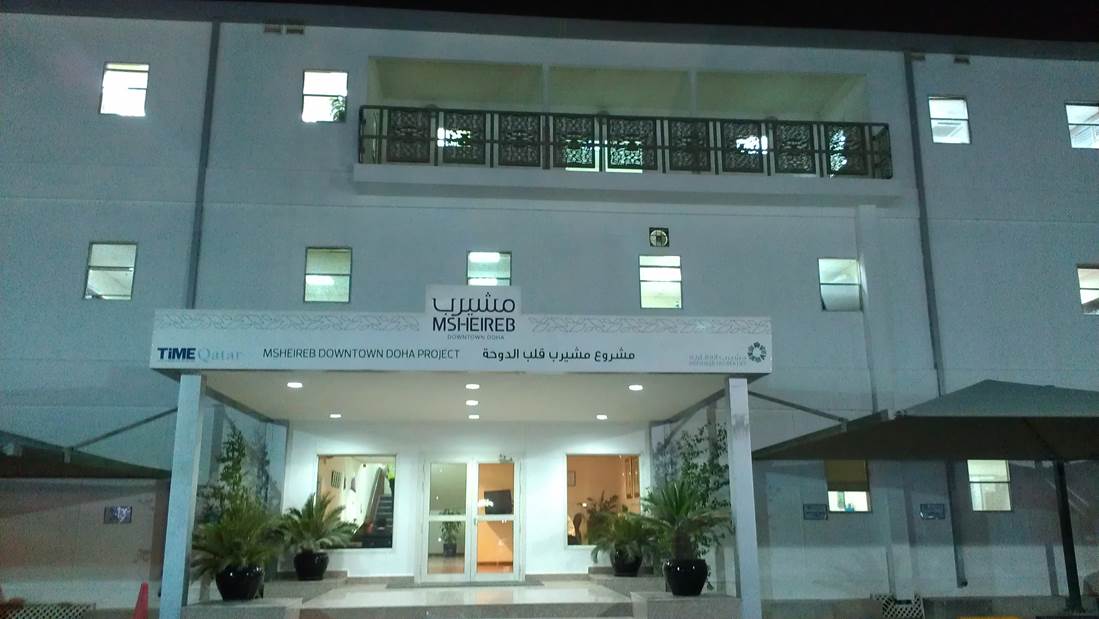
Mshiereb: Our Doha "What/Why"

A slice of Mshiereb at Night - someone is working in the Big Hole 24/7
 
Here's what I know about Bob's employment in Doha:
 
The project is big.  In the billion dollar plus range. In a "wow, that's a Big Hole surrounded by chain link you got there" and a "cheez, them's a lot of cranes" kind of way.
 
The project is important.  A special viewing balcony overlooks the Big Hole to accommodate Sheikha Moza's visits to the job site.
 
The project is complicated.  Phase One A involves construction of four buildings, including a National Archive, Eid prayer ground and the Diwan Annex.  Phase One B consists of 27 diverse structures: hotels, apartments, offices, retail and mixed-used buildings, a mosque and more.  Phase One C consists of a school, townhomes and office buildings. The project employs thousands of people from all over the world.
 
There are more phases.  At this moment, Bob's company is not involved in them.
 
The color of a worker's hard hat identifies his/her function onsite:
 
white - manager/supervisor
red - safety guys
yellow - regular workers
blue - skilled workers
green - security personnel
 
(The function relative to the color of each hat may differ depending upon the project and the companies involved.)
 
Bob wears a white hat.
 
Each morning, six days/week, Bob rises at 5:30am.  He showers, dons business casual, swigs a cuppa Folgers Medium Classic and is out the door by 6:15am.  At the job site, he sits at a desk inside a trailer overlooking the Big Hole.
 
Job Site Trailer - front door
 
Construction packets create mountains, hills and valleys across his desk.  He reviews packet drawings, writes emails, makes phone calls, participates in meetings.  
 
Bob and Randy confer
 
Sometimes Bob likes what he sees in the drawings.  At these moments there is great joy inside the Big Hole.
 
Sometimes Bob doesn't like what he sees in the drawings.  There is gnashing of teeth inside the Big Hole.
 
Sometimes the issue concerns areas prematurely constructed.  Wailing and beating of chests pours out of the Big Hole.  (Just before the sounds of ripping, tearing and rebuilding begins…)
 
I pick Bob up each day between 5-6pm.  Sometimes he's ready to go.  Sometimes he's meeting with a contractor and I get some extra study time in.  Sometimes he's not there and I get to wait longer.
 
 
Waiting on Bob in Doha
 
Not long ago there was a chicken coop/garden overlooking the Big Hole.  One day, with no fanfare, a group of yellow hats tore it down.  I never learned the official reason for the coop's presence except that "Sheikha Moza want(ed) it there."

 
As this first part of the project whittles to a conclusion, Bob spends more time inside the Big Hole.  He climbs to the roof tops of buildings, looks over protected ledges and safely navigates sky-high scaffolding.  He wears steel-toed boots, hard hat, safety harness, safety glasses, jeans, tee shirt and a bright yellow vest for job site visits.
 
Bob, white hat, yellow vest, steel-toed boots
 
Want to know more?  Here's an official project video, published by Mshiereb on July 2, 2012:


Thursday, January 24, 2013

Why Do Qatari Men Touch Noses?

Watch this funny video from Iranian-American comedian Maz Jobrani for the answer:
 
  
I know, I know - I promised:  a blog every Friday, no matter what.  But today…I'm just too tired.  After a (busy, but fun) week of 9-hour and an 11-hour shifts with students at Weill Cornell Medical College.  A week of early mornings, hurried shopping, midnight laundry.
 
A week of language classes missed.
 
A week of sunshine lost.
 
I'm befuddled in English, confused in Arabic, mixed up in Khaleeji, Masri, FusHa.
 
There are the usual distractions muddling my horizon - half marathon training after a long setback.  Missing family, faraway car troubles, taxes due, FAFSAs to complete…five babies I haven't seen in way. too. long.
 
And new distractions like Bob's guys-go-golf trip to ABU DHABI this weekend (clicker to myself! Snacks and sweatpants in front of the tv!) and deciding if I should run tomorrow's inaugural "Doha Marathon" along the Corniche - just advertised in yesterday's paper.
 
If I were blogging today I might write about stuff in the news…for example how all women (teachers, administrators, support staff) were suddenly banned from working in Independent Boys' Schools (ie, Qatari public schools). "For fear that (young boys) may start imitating their behavior or mannerisms."  (Doha News Link)
 
Or about Sheikha Moza's nanny training school where "the goal of the academy (is to) protect children from other cultures that diffuse into the society through Asian nannies in particular." (Doha News Link)

Or maybe I'd tell you about red suburbans and motorcycles and drivers with guns who park in the middle of roundabouts, blocking/clogging roads, so whomever-high-up can get from here to there unimpeded.  And how it used to be interesting to watch the long line of black cars stream past and wonder, who-might-that-be?  But now when I see those speeding flashes of red…I whip the car around and consider how wide a circle I'll have to make to avoid the inevitable traffic backup. 
 
 
unrelated palm trees pic
 
Nope, I'm just not up to blogging today. Instead I'm gonna watch another funny video, drink some coffee and…wait for the sun.


Sunday, February 5, 2012

The Sheikha and the Chickens

Why is there a chicken coop overlooking the massive hole in the ground from which the Heart of Doha, Musheireb, will rise?

Giant Hole

Chicken Coop Overlooking Giant Hole

The answer: “The Sheikha wants them there.”

That would be Her Highness Sheikha Mozah bint Nasser al Missned, the Emir’s (second) wife - and Chairperson of the Qatar Foundation for Education, Science and Community Development; President of the Supreme Council for Family Affairs; Vice Chair, the Supreme Education Council; Vice Chair, Supreme Health Council; Chair, Sidra Medical and Research Center; Chair, Silatech; UNESCO’s Special Envoy for Basic and Higher Education; and Member of the High Level Group, UN Alliance of Civilizations. The Times of London named her one of the 25 most influential business leaders in the Middle East and she’s on Forbes’ list of the world’s 100 most powerful women.

As if all that weren’t enough, Sheikha Mozah holds a sociology degree from Qatar University, has been awarded multiple honorary degrees - and she has seven children!

Think you know all about the “oppressed and invisible” Middle Eastern woman? Think again.

At the Heart of Doha, Musheireb’s groundbreaking ceremony, Sheikha Mozah set her palm print into the building’s cornerstone.  Nearby, her image appeared on a television screen.  She said:
“Our past clearly reflected that communities in Qatar have always
been close knit.  People lived and worked together in harmony with
the climate, with the land and with each other.  We had our own
ways of dealing with our environment which was sustainable and
human in scale, and thus, our architecture reflected the unity of
our family’s identity.”

Since the discovery of oil and gas in the 1930s, this little pearl and fishing village has grown into a booming, busy metropolis. There’s a building shaped like a bullet and another in zigzag form. There are resorts and yachts and malls.  High profile sports events are held here.  The country has its own airline.

With all that development comes advancement – Education City, for example. On the down side, Qatar has one of the highest rates of diabetes in the Middle East and a generation of youth that (…reputedly…) prefers not to work.

A nation can’t stop moving forward for fear of losing sight of its roots or otherwise outgrowing its civvies.  Instead, leadership finds creative ways to remind those on the developmental front lines to stay true to the country’s heritage and culture.

She brings in the chickens.